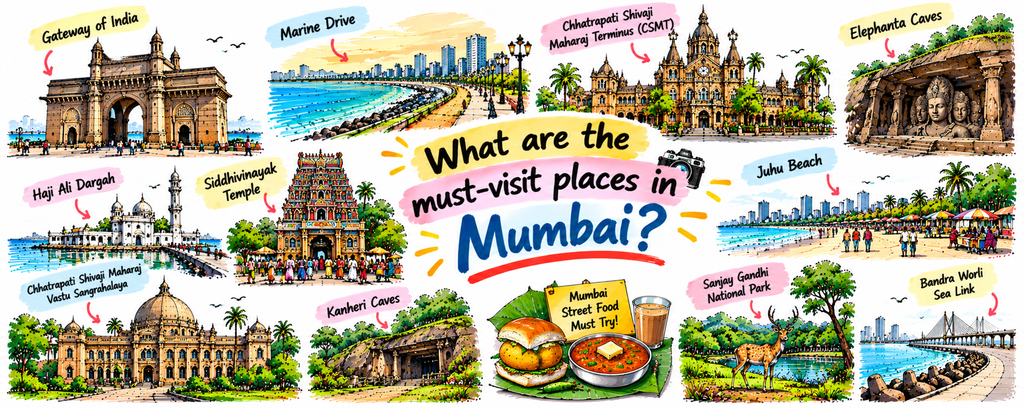
Mumbai is a city where history, sea views, food, culture, architecture, shopping, and modern life come together. The city offers something different in almost every neighborhood.
For a first visit, travelers can explore famous landmarks such as the Gateway of India, Marine Drive, Chhatrapati Shivaji Maharaj Terminus, Elephanta Caves, Haji Ali Dargah, and Siddhivinayak Temple. Nature lovers can also explore Sanjay Gandhi National Park and Kanheri Caves, while visitors looking for beaches and local food can spend time at Juhu Beach. Maharashtra Tourism lists these among Mumbai’s important attractions.
The best way to explore Mumbai is to avoid treating it as a simple checklist. Instead, group places by area and choose experiences that match your interests.
Quick Guide to Mumbai’s Must-Visit Places
| Place | Best For | Suggested Time |
|---|---|---|
| Gateway of India | History and architecture | 1–2 hours |
| Marine Drive | Sea views and evening walks | 1–2 hours |
| CSMT | Heritage architecture | 1 hour |
| Elephanta Caves | History and rock-cut art | Half day |
| Chhatrapati Shivaji Maharaj Vastu Sangrahalaya | Art and history | 2–3 hours |
| Haji Ali Dargah | Architecture and spirituality | 1–2 hours |
| Siddhivinayak Temple | Religious tourism | 1–2 hours |
| Juhu Beach | Beach and street food | 1–2 hours |
| Sanjay Gandhi National Park | Nature and wildlife | Half day |
| Kanheri Caves | Buddhist heritage | Half day |
The exact time can vary depending on crowds, weather, transport, and how deeply you want to explore each location.
1. Gateway of India
The Gateway of India is one of Mumbai’s most recognizable landmarks.
The monument stands beside the Arabian Sea and represents an important part of Mumbai’s colonial-era history. Maharashtra Tourism identifies the Gateway as one of the city’s major historical monuments.
The waterfront also gives visitors a chance to experience Mumbai’s busy harbor atmosphere.
What Can You Do Here?
Visitors can:
- See the Gateway’s architecture
- Walk along the waterfront
- Enjoy views of the Arabian Sea
- Take photographs
- Explore nearby Colaba
- Combine the visit with museums and shopping
The Gateway is particularly useful as a starting point for exploring South Mumbai.
2. Marine Drive
Marine Drive is one of Mumbai’s most famous coastal areas.
The curved road runs along the Arabian Sea and is popularly known as the “Queen’s Necklace” because of the appearance of its streetlights after dark. Maharashtra Tourism highlights Marine Drive for its coastal views, walking experience, and evening atmosphere.
It is not a place that requires a complicated sightseeing plan.
Simply walking along the promenade can become one of the most memorable parts of a Mumbai trip.
Best Experience
Visit around:
- Early morning
- Sunset
- Evening
The evening is especially popular because the coastline becomes lively as the city lights come on.
3. Chhatrapati Shivaji Maharaj Terminus
The Chhatrapati Shivaji Maharaj Terminus, commonly known as CSMT, is both a working railway station and an important architectural landmark.
Maharashtra Tourism describes it as a UNESCO World Heritage Site built in 1887, combining Victorian Gothic Revival elements with Indian architectural influences.
Even if you are not traveling by train, it is worth seeing the exterior.
Look For
- Detailed stonework
- Domes
- Arches
- Decorative carvings
- Gothic architectural elements
- Indian design influences
Photography enthusiasts can spend time observing the details rather than simply taking one quick photograph.
4. Elephanta Caves
The Elephanta Caves offer a completely different experience from Mumbai’s busy streets.
They are located on Elephanta Island, roughly 10 km from Mumbai, and visitors generally reach the island by ferry from the Gateway of India. The journey takes about an hour.
The caves are famous for their rock-cut architecture and sculptures, especially the large Trimurti sculpture of Shiva in Cave 1.
The site is recognized as a UNESCO World Heritage Site.
Why Visit Elephanta Caves?
It is a good choice for travelers interested in:
- Ancient architecture
- Sculpture
- Indian history
- Religious art
- Photography
- Heritage
Because the island requires a ferry journey and walking, allow several hours rather than treating it as a quick stop.
5. Chhatrapati Shivaji Maharaj Vastu Sangrahalaya
Previously known as the Prince of Wales Museum, the Chhatrapati Shivaji Maharaj Vastu Sangrahalaya is located near the Gateway of India area.
The museum houses collections that include sculptures, manuscripts, decorative arts, and other objects connected with India’s cultural history. Maharashtra Tourism specifically recommends the museum as part of the South Mumbai heritage experience.
Who Should Visit?
This museum is especially suitable for:
- History lovers
- Art enthusiasts
- Families
- Students
- International travelers
If you enjoy museums, allow a few hours instead of rushing through the galleries.
6. Haji Ali Dargah
Haji Ali Dargah is an important religious and architectural landmark located on a small islet off Mumbai’s coast.
The site is connected to the mainland by a narrow causeway and is known for its Indo-Islamic architectural character. Maharashtra Tourism lists it among Mumbai City’s major religious attractions.
The surrounding coastal setting adds to the experience.
Things to Keep in Mind
Visitors should:
- Dress respectfully
- Follow local rules
- Check access conditions
- Allow enough time for the walk
- Avoid treating the site only as a photo stop
7. Siddhivinayak Temple
The Siddhivinayak Temple in Prabhadevi is one of Mumbai’s well-known religious landmarks.
The temple is dedicated to Lord Ganesha and attracts large numbers of devotees and visitors. Maharashtra Tourism identifies it as one of Mumbai’s significant places of worship.
If you plan to visit, remember that this is an active place of worship.
A Better Way to Visit
Check the current temple timings and visitor arrangements before going.
Keep the visit respectful and allow extra time if there are long queues.
8. Juhu Beach
Juhu Beach offers another side of Mumbai.
Instead of grand monuments and historic architecture, you get a lively coastal setting with local food and evening activity.
Maharashtra Tourism highlights Juhu Beach for its coastal atmosphere, street food, and sunset views.
What Should You Try?
Visitors can experience popular Mumbai snacks such as:
- Vada pav
- Pav bhaji
- Bhel puri
- Sev puri
- Pani puri
Maharashtra Tourism identifies these foods as part of Mumbai’s famous street-food culture.
9. Sanjay Gandhi National Park
Mumbai is not only about buildings and beaches.
Sanjay Gandhi National Park provides a large green space within the metropolitan region.
It is suitable for travelers who want:
- Nature
- Wildlife
- Green landscapes
- Outdoor activities
- A break from the busy city
The park also provides access to the historic Kanheri Caves, creating an interesting combination of nature and heritage. Maharashtra Tourism lists both the park and Kanheri Caves among Mumbai’s attractions.
10. Kanheri Caves
The Kanheri Caves are located within Sanjay Gandhi National Park.
These ancient rock-cut monuments provide an opportunity to explore Mumbai’s Buddhist heritage.
The caves include architectural features associated with Buddhist monastic life and are carved into the surrounding hills. Maharashtra Tourism describes them as an important example of rock-cut architecture within the national park.
Best For
Kanheri Caves are particularly interesting for:
- History lovers
- Architecture enthusiasts
- Photographers
- Students
- Heritage travelers
Plan this visit as part of a larger Sanjay Gandhi National Park outing.
Mumbai Attractions by Travel Interest
Choosing places becomes easier when you know what type of experience you want.
| Travel Interest | Recommended Places |
|---|---|
| History | Gateway of India, CSMT, Elephanta Caves |
| Architecture | CSMT, Gateway of India |
| Beaches | Marine Drive, Juhu Beach |
| Museums | CSMVS |
| Religious sites | Haji Ali Dargah, Siddhivinayak Temple |
| Nature | Sanjay Gandhi National Park |
| Ancient heritage | Elephanta Caves, Kanheri Caves |
| Street food | Juhu Beach and local food areas |
| Photography | Marine Drive, Gateway of India, CSMT |
| Shopping | Colaba and other local markets |
Which Mumbai Places Can You Visit Together?
Planning by area can save significant travel time.
South Mumbai
You can combine:
- Gateway of India
- CSMVS
- Colaba
- CSMT
- Marine Drive
This makes a good heritage-focused day.
Central and South-Central Mumbai
You can consider:
- Haji Ali Dargah
- Siddhivinayak Temple
- Marine Drive
Western Mumbai
You can explore:
- Juhu Beach
- Local food areas
- Nearby cultural attractions
Northern Mumbai
Consider:
- Sanjay Gandhi National Park
- Kanheri Caves
This grouping makes it easier to create a practical itinerary.
A Simple 3-Day Mumbai Itinerary
If this is your first Mumbai trip, three days can provide a useful introduction to the city’s major experiences.
Day 1 – South Mumbai Heritage
Morning
Start at the Gateway of India.
Spend time around the waterfront.
Late Morning
Visit the Chhatrapati Shivaji Maharaj Vastu Sangrahalaya.
Afternoon
Explore Colaba and have lunch.
Evening
Visit Marine Drive.
Finish the day with a coastal walk.
Day 2 – History and Culture
Morning
Visit CSMT and explore its architecture.
Afternoon
Visit another cultural or heritage attraction.
Evening
Explore local food.
Try:
- Vada pav
- Pav bhaji
- Bhel puri
- Sev puri
Maharashtra Tourism specifically highlights these foods as part of Mumbai’s culinary identity.
Day 3 – Choose Your Experience
Option A: Elephanta Caves
Take a ferry from the Gateway of India and spend several hours exploring the island and caves.
Option B: Nature and Heritage
Visit:
Sanjay Gandhi National Park + Kanheri Caves
Option C: Beach and Local Life
Visit:
Juhu Beach + nearby areas
This option works well if you prefer a relaxed final day.
How Many Days Are Needed for Mumbai?
The Maharashtra Tourism Department lists an ideal duration of 3–5 days for Mumbai City.
A practical breakdown looks like this:
| Duration | Suggested Focus |
|---|---|
| 1 Day | Gateway + Marine Drive + one major attraction |
| 2 Days | South Mumbai + beaches + heritage |
| 3 Days | Major landmarks + one special experience |
| 4 Days | City attractions + Elephanta or Kanheri |
| 5 Days | Mumbai at a slower pace + additional experiences |
For first-time visitors, 3 days is a useful starting point. Travelers who enjoy museums, heritage, food, shopping, and neighborhoods may prefer four or five days.
What Mumbai Food Should Travelers Try?
Food is an important part of the Mumbai experience.
Popular Choices
| Food | What It Is |
|---|---|
| Vada Pav | Spiced potato fritter served in a bun |
| Pav Bhaji | Spiced vegetable mash with buttered bread |
| Bhel Puri | Puffed rice snack with chutneys |
| Sev Puri | Crispy snack topped with chutneys and sev |
| Pani Puri | Small crisp shells filled with flavored water and fillings |
| Bombil Fry | Fried Bombay duck, associated with Mumbai’s coastal cuisine |
Maharashtra Tourism lists vada pav, pav bhaji, bombil fry, bhel puri, pani puri, and sev puri among Mumbai’s notable foods.
Practical Tips for Exploring Mumbai
1. Plan Around Traffic
Mumbai is a large and busy metropolitan city.
Do not schedule attractions across distant parts of the city without allowing enough travel time.
2. Group Attractions
Visit nearby places together.
This gives you more time for sightseeing.
3. Start Early
Morning sightseeing can be more comfortable, especially for outdoor attractions.
4. Keep an Evening Free
Mumbai is worth experiencing after sunset.
Marine Drive is particularly suitable for an evening walk.
5. Check Timings Before Visiting
Museum, temple, park, and heritage-site timings can change.
6. Carry Comfortable Footwear
Several attractions involve walking.
This is especially useful for Elephanta and Kanheri.
7. Keep Cash and Digital Payment Options
Small food stalls and local shops may have different payment preferences.
Best Time to Visit Mumbai
Maharashtra Tourism identifies October to February as the preferred period for sightseeing, with cooler conditions than the hotter months. It also notes that the monsoon from June to September can suit travelers interested in greenery and waterfalls, although heavy rain can affect outdoor plans.
If your itinerary focuses heavily on beaches, walking, and outdoor sightseeing, check the weather forecast before traveling.
Frequently Asked Questions
What are the most famous places to visit in Mumbai?
Some of Mumbai’s major attractions include the Gateway of India, Marine Drive, CSMT, Elephanta Caves, Haji Ali Dargah, Siddhivinayak Temple, Juhu Beach, Sanjay Gandhi National Park, and Kanheri Caves.
Is 2 days enough to explore Mumbai?
Two days can cover several major attractions, especially if you focus on South Mumbai and organize your itinerary by location.
Is 3 days enough for Mumbai?
Three days can provide a balanced first introduction to Mumbai, including heritage, beaches, food, and one additional experience such as Elephanta Caves.
What should I see first in Mumbai?
For a first visit, you can begin with the Gateway of India and nearby South Mumbai attractions, then explore Marine Drive and another part of the city.
Are Elephanta Caves worth adding to a Mumbai itinerary?
They are particularly useful for travelers interested in ancient rock-cut architecture, sculpture, history, and heritage. The caves are accessible by ferry from the Gateway of India.
What is Mumbai famous for?
Mumbai is known for its coastal setting, historical architecture, religious landmarks, diverse culture, entertainment industry, business activity, and distinctive street food. Maharashtra Tourism describes it as India’s financial and commercial hub with a vibrant cultural identity.
Final Thoughts
Mumbai is much more than a collection of famous landmarks.
The Gateway of India shows its historic side. CSMT highlights its remarkable architecture. Marine Drive provides the classic coastal experience. Elephanta and Kanheri Caves reveal older layers of India’s heritage. Meanwhile, Juhu Beach, local markets, temples, and street food help visitors experience everyday Mumbai.
If you have limited time, focus on a few places and enjoy them properly.
If you have three to five days, you can explore the city at a more comfortable pace and add a combination of museums, beaches, heritage sites, food experiences, and nature.
The most useful approach is to choose attractions based on your interests and group them by location.
That way, your Mumbai trip becomes less about rushing between landmarks and more about understanding the many sides of the city.
Quick Mumbai Travel Checklist
☐ Gateway of India
☐ Marine Drive
☐ Chhatrapati Shivaji Maharaj Terminus
☐ Elephanta Caves
☐ Chhatrapati Shivaji Maharaj Vastu Sangrahalaya
☐ Haji Ali Dargah
☐ Siddhivinayak Temple
☐ Juhu Beach
☐ Sanjay Gandhi National Park
☐ Kanheri Caves
☐ Try Mumbai street food
☐ Keep time for an evening Marine Drive walk
☐ Check attraction timings before visiting
Hashtags
#MumbaiTravel · #MumbaiTourism · #VisitMumbai · #MumbaiTrip · #MaharashtraTourism · #IndiaTravel · #MumbaiTour
