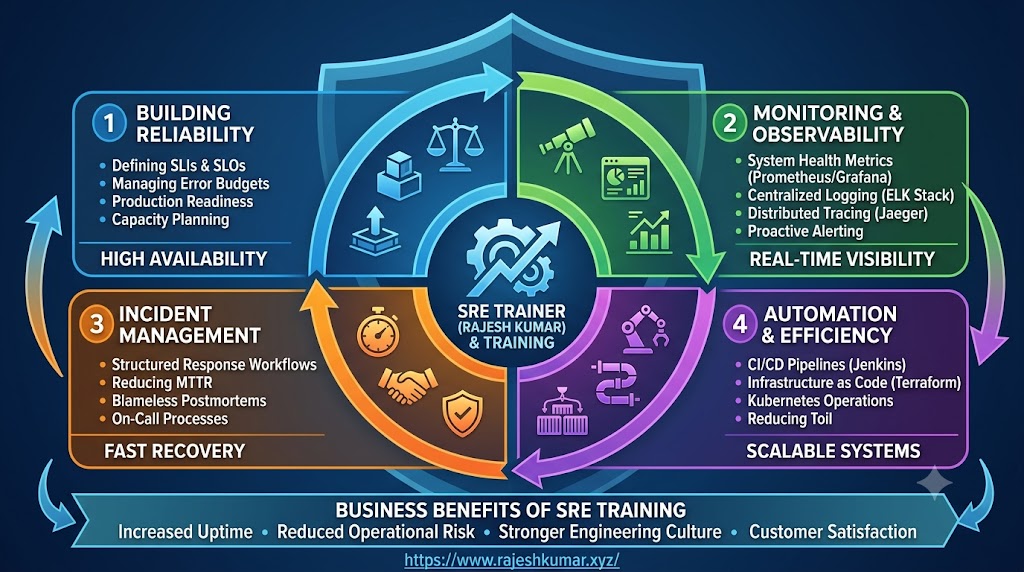
Introduction
Modern digital systems demand high availability, fast recovery, and consistent performance. As applications become more distributed across cloud-native environments, maintaining reliability is no longer optional—it is a core engineering requirement.
This is where Site Reliability Engineering (SRE) becomes essential. It combines software engineering principles with operations to build scalable, resilient systems.
An experienced SRE Trainer plays a critical role in helping engineering teams develop reliability-focused skills in monitoring, incident response, automation, and system observability.
Without structured training, teams often struggle with frequent outages, slow incident resolution, and lack of visibility into production systems.
Who Is Rajesh Kumar?
Rajesh Kumar is a seasoned DevOps, SRE, and cloud engineering professional who helps organizations build reliable, scalable, and automated production systems.
His expertise focuses on practical implementation of:
- Site Reliability Engineering practices
- DevOps transformation and automation
- Cloud-native architecture
- Kubernetes operations and scaling
- DevSecOps integration
- Platform engineering adoption
He works closely with enterprise engineering teams to improve production stability, monitoring maturity, and incident management processes.
More details can be explored here: https://www.rajeshkumar.xyz/
Rajesh Kumar DevOps Consulting & Training
Why Organizations Need an SRE Trainer
Many organizations adopt cloud-native systems but lack structured reliability practices. Without proper guidance, teams often face:
- Frequent production downtime
- Slow incident detection and resolution
- Lack of clear monitoring systems
- Poor observability across services
- Inefficient on-call processes
An SRE Trainer helps engineering teams build strong foundations in reliability engineering by focusing on real-world production challenges.
Key areas covered include:
- Service reliability fundamentals
- Monitoring and alerting systems
- Incident management workflows
- Automation of operational tasks
- Performance optimization strategies
This training ensures teams can proactively prevent failures instead of reacting to them.
DevOps and SRE Relationship
SRE builds on DevOps principles but focuses more on system reliability and operational excellence.
While DevOps emphasizes collaboration and automation, SRE adds:
- Reliability metrics (SLIs and SLOs)
- Error budgets
- Structured incident response
- Production readiness practices
A strong SRE foundation ensures that DevOps practices are not only fast but also stable and reliable in production environments.
SRE Trainer for Reliability Engineering Skills
A skilled SRE Trainer focuses on teaching engineers how to build and maintain reliable systems.
Key learning areas include:
- Designing SLIs and SLOs
- Monitoring system health and performance
- Building alerting strategies
- Reducing mean time to recovery (MTTR)
- Preventing recurring incidents
The training is practical and based on real production scenarios rather than theoretical concepts.
Site Reliability Engineering Training for Production Systems
Site Reliability Engineering Training helps teams build confidence in handling production systems at scale.
It includes:
- Incident detection and response strategies
- Capacity planning and scaling
- Load testing and performance analysis
- Logging and observability tools
- Disaster recovery planning
This ensures systems remain stable even under unpredictable workloads and failures.
SRE Consultant for Enterprise Reliability
An SRE Consultant works with organizations to improve reliability maturity at scale.
Consulting includes:
- Designing reliability frameworks
- Improving incident management processes
- Implementing observability platforms
- Establishing on-call best practices
- Defining SLO-driven engineering culture
This helps enterprises move from reactive firefighting to proactive reliability engineering.
Monitoring and Observability in SRE
Monitoring and observability are core pillars of SRE practices.
Key components include:
- Metrics for system performance
- Centralized logging systems
- Distributed tracing
- Alerting and dashboards
- Real-time anomaly detection
A strong observability setup allows teams to detect issues before they impact end users.
Incident Management Best Practices
Effective incident management is critical for production systems.
An SRE-driven approach includes:
- Incident classification and prioritization
- Clear escalation paths
- Post-incident reviews (blameless postmortems)
- Root cause analysis
- Continuous improvement cycles
These practices help reduce downtime and improve system resilience over time.
SRE in Cloud-Native and Kubernetes Environments
Modern applications run on cloud platforms and Kubernetes clusters, making SRE practices even more important.
SRE teams focus on:
- Container reliability
- Cluster health monitoring
- Autoscaling strategies
- Resource optimization
- Multi-region availability
This ensures Kubernetes-based systems remain stable under production load.
Tools and Technologies Covered
| Area | Tools / Topics | Business Value |
|---|---|---|
| Monitoring | Prometheus, Grafana | Real-time system visibility |
| Logging | ELK Stack | Centralized log analysis |
| Tracing | Jaeger, OpenTelemetry | End-to-end request tracking |
| CI/CD | Jenkins Training | Reliable deployment pipelines |
| Infrastructure | Terraform Training | Automated infrastructure provisioning |
| Containers | Docker Kubernetes Training | Scalable deployments |
| Cloud | AWS DevOps | Cloud reliability and scaling |
| Security | DevSecOps | Secure system operations |
| Automation | SRE Practices | Reduced manual workload |
| Reliability | SLO/SLI frameworks | Predictable system behavior |
Why Choose SRE Training
Organizations invest in SRE training because it provides:
- Higher system uptime and availability
- Faster incident detection and resolution
- Better visibility into production systems
- Reduced operational risk
- Improved engineering productivity
- Stronger automation culture
- More predictable system performance
It transforms operations from reactive support to proactive engineering.
Best Fit Audience
SRE Training is ideal for:
- DevOps engineers
- Site reliability engineers
- Cloud engineers
- Platform engineering teams
- Production support teams
- Software developers working on distributed systems
- IT operations teams
- Engineering managers
It is especially valuable for teams managing cloud-native and Kubernetes environments.
Business Benefits of SRE Training
Organizations adopting SRE practices experience:
- Reduced system downtime
- Faster incident recovery
- Improved application performance
- Better scalability under load
- Enhanced monitoring and visibility
- Lower operational costs
- Increased customer satisfaction
- Stronger engineering reliability culture
These benefits directly improve business continuity and user experience.
FAQs
Why should companies hire an SRE Trainer?
An SRE Trainer helps teams build reliability, monitoring, and incident management skills for production systems.
What does an SRE Consultant do?
An SRE Consultant improves system reliability by designing monitoring, incident response, and automation frameworks.
Who should attend Site Reliability Engineering Training?
DevOps engineers, cloud engineers, and operations teams managing production systems should attend.
How does SRE improve production systems?
It introduces reliability metrics, automation, and structured incident management to reduce downtime.
Why is monitoring important in SRE?
Monitoring provides visibility into system health and helps detect issues before they impact users.
Conclusion
Site Reliability Engineering is essential for maintaining stable, scalable, and high-performing systems in modern cloud environments. However, successful implementation requires the right skills, mindset, and structured guidance.
An experienced SRE Trainer helps engineering teams build expertise in reliability, monitoring, observability, and incident management—ensuring systems remain resilient under real-world production conditions.
Organizations looking to strengthen their reliability engineering capabilities can explore expert-led training and consulting at:
https://www.rajeshkumar.xyz/
With the right SRE foundation, teams can achieve higher uptime, faster recovery, and stronger production stability.
