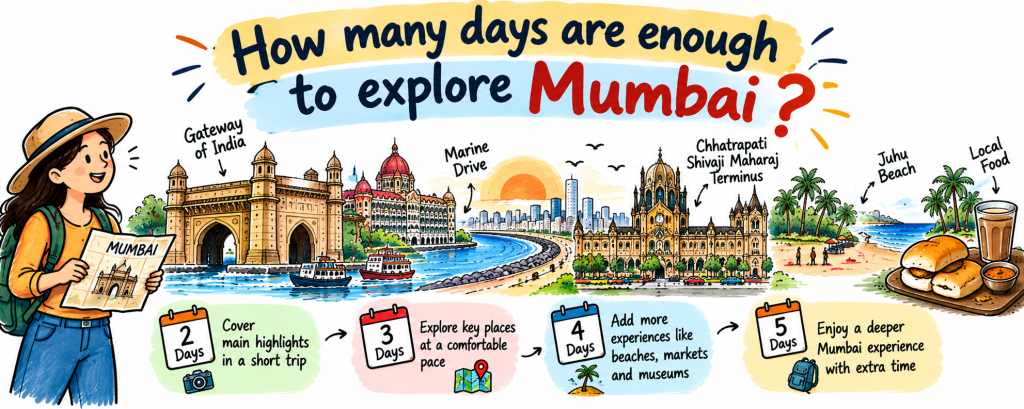
Mumbai is a city that can take time to understand.
It is not only about famous landmarks.
The city combines historic buildings, beaches, markets, religious places, museums, food, art, shopping, and busy local neighbourhoods.
That is why many first-time visitors ask an important question:
How many days are enough to explore Mumbai?
For most first-time visitors, 3 to 5 days is a practical duration.
Maharashtra Tourism currently lists 3–5 days as Mumbai’s ideal duration. A shorter visit can still cover major highlights, while five days gives you more time to explore different parts of the city without making every day too busy.
The right duration also depends on what you want to see.
A traveller interested mainly in famous landmarks may manage with two days.
Someone who wants to explore Mumbai’s history, food, markets, beaches, culture, and nearby attractions should consider staying longer.
Is 2 Days Enough for Mumbai?
Two days can work if you have limited time.
You will not explore the whole city, but you can experience several important highlights.
The official Incredible India website has a dedicated 48-hour Mumbai itinerary featuring places such as the Gateway of India, Elephanta Caves, Kala Ghoda, and Marine Drive.
A two-day visit should focus on areas that can be combined naturally.
You could spend one day exploring South Mumbai.
The second day can focus on another part of the city, along with food or a relaxed evening.
Do not try to add every attraction to these two days.
Travel time can quickly make a packed itinerary tiring.
What Can You See in 2 Days?
A simple two-day structure could look like this:
| Day | Main Focus | Experiences |
|---|---|---|
| Day 1 | South Mumbai | Gateway of India, Colaba, heritage areas, museum, Marine Drive |
| Day 2 | Mumbai’s wider city experience | Beach or neighbourhood exploration, food, shopping, cultural attractions |
This is only a framework.
Your actual route should depend on opening hours, weather, traffic, and personal interests.
Is 3 Days Enough for Mumbai?
For many first-time visitors, three days offers a useful balance.
You can explore the major historic areas without spending the entire trip moving between attractions.
You can also add a beach, market, food experience, or cultural attraction.
Maharashtra Tourism’s current Mumbai itinerary system also presents a three-stop city experience covering the Gateway of India and Colaba, the museum and Kala Ghoda area, and Marine Drive with Girgaon Chowpatty.
A three-day trip can therefore give you a broad introduction to Mumbai.
It will still leave many parts of the city unexplored.
That is completely fine.
Mumbai is too large to experience properly through a short checklist.
A Practical 3-Day Mumbai Plan
Day 1: Gateway of India and South Mumbai
Start with the Gateway of India.
The monument stands on the waterfront at Apollo Bunder and overlooks the Arabian Sea. It was completed in 1924.
From there, explore Colaba.
You can walk through the surrounding heritage areas and visit nearby attractions.
Depending on your interests, you can also explore a museum or the Kala Ghoda area.
Finish the day around Marine Drive.
Marine Drive is one of Mumbai’s most recognisable coastal spaces and is known for its curved waterfront and evening city lights.
Day 2: History, Culture and Local Life
Use the second day to explore another side of Mumbai.
You could visit Chhatrapati Shivaji Maharaj Terminus.
The station is a UNESCO World Heritage Site and combines Victorian Gothic architecture with Indian design influences.
You can then explore local markets or religious landmarks.
Depending on your interests, you might visit Haji Ali Dargah, Siddhivinayak Temple, or another cultural site.
Leave some time for local food.
Mumbai’s street food is an important part of the city’s everyday culture.
Day 3: Choose Your Main Experience
The third day gives you more flexibility.
You could visit Elephanta Caves.
You could explore a beach.
You could spend time in another neighbourhood.
You could focus on shopping or food.
You could also explore Sanjay Gandhi National Park and Kanheri Caves if nature and history interest you.
The key is to choose one main direction rather than trying to cover everything.
Should You Stay 4 Days in Mumbai?
Four days can make the trip more comfortable.
You can explore the main landmarks and still have time for experiences that require more travel.
This is useful if you do not want to rush.
A fourth day can also help if your arrival or departure takes up part of your first or last day.
You can use the extra time for:
- Elephanta Caves
- Sanjay Gandhi National Park
- Kanheri Caves
- Juhu Beach
- Local markets
- Shopping
- Museums
- Food exploration
- Cultural experiences
The best choice depends on your interests.
You do not need to visit every place simply because you have another day.
Is 5 Days Too Long for Mumbai?
No.
Five days can be useful for visitors who want to experience Mumbai beyond its most famous landmarks.
Maharashtra Tourism currently identifies 3–5 days as the ideal duration for Mumbai.
With five days, you can spread sightseeing across different parts of the city.
You can also keep one day more flexible.
That matters because Mumbai is a busy city.
Traffic, weather, walking, public transport, and unexpected delays can affect your schedule.
Having some extra time reduces the pressure to complete every activity exactly as planned.
What Can You Do With 5 Days?
A five-day trip could be structured around different experiences.
| Day | Suggested Focus |
|---|---|
| Day 1 | Gateway of India, Colaba and South Mumbai |
| Day 2 | CSMT, heritage areas, museum and local markets |
| Day 3 | Elephanta Caves or another major excursion |
| Day 4 | Beach, neighbourhoods, shopping and food |
| Day 5 | Nature, culture or relaxed exploration |
This is not a fixed tour package.
You can move the activities around according to opening days, weather, transport, and your interests.
What About Elephanta Caves?
Elephanta Caves deserve separate planning.
The caves are located on Elephanta Island, around 10 kilometres from Mumbai, and visitors normally reach the island by ferry from the Gateway of India. Maharashtra Tourism says the ferry journey takes roughly an hour.
The site is a UNESCO World Heritage Site.
It is known for rock-cut temples and the famous Trimurti sculpture associated with Shiva.
Because the visit involves a ferry journey and time on the island, do not squeeze it into an already overloaded day.
Give the experience enough time.
Also check the latest operating information before travelling.
What About Sanjay Gandhi National Park?
Nature lovers can consider Sanjay Gandhi National Park.
It offers a different experience from the dense urban areas of Mumbai.
The park also provides access to the historic Kanheri Caves.
Maharashtra Tourism describes the area as a combination of natural surroundings and ancient Buddhist rock-cut monuments.
This can be a useful addition to a longer Mumbai trip.
It may be less practical for a very short visit if your main goal is South Mumbai.
What About Mumbai’s Beaches?
Mumbai’s coastline is part of the city’s identity.
Marine Drive is one of the most famous places for enjoying the sea and city skyline.
Juhu Beach offers another coastal experience.
Maharashtra Tourism lists both Marine Drive and Juhu Beach among Mumbai’s attractions.
You do not need to visit every beach.
Choose one based on where it fits into your route.
Make Time for Mumbai’s Food
A Mumbai trip is not complete for many visitors without trying local food.
You can find popular options such as:
- Vada pav
- Pav bhaji
- Bhel puri
- Sev puri
- Pani puri
- Bombay sandwich
- Local seafood
Maharashtra Tourism specifically highlights vada pav, pav bhaji, bhel puri, pani puri, sev puri, and Bombil fry among Mumbai’s food experiences.
You do not need to plan an entire day around food.
Instead, add local food stops to your sightseeing route.
If you have allergies or dietary restrictions, ask about ingredients before ordering.
Explore Mumbai’s Markets
Markets can show you another side of the city.
Colaba Causeway is one option for visitors interested in shopping and street life.
Maharashtra Tourism also highlights shopping and local markets as part of the Mumbai experience.
You can look for clothing, accessories, souvenirs, handicrafts, and other products.
If you plan to buy something expensive, compare products and understand the seller’s terms before paying.
Experience Mumbai’s Architecture
Mumbai has several important architectural areas.
South Mumbai is especially useful for visitors interested in historic buildings.
The city also has a recognised Victorian Gothic and Art Deco heritage.
Incredible India highlights Mumbai’s Victorian and Art Deco architectural heritage along with the UNESCO-listed Chhatrapati Shivaji Maharaj Terminus.
A heritage walk can therefore add something different to a standard sightseeing trip.
You can slow down and notice building details rather than simply taking photographs.
Do You Need More Than 5 Days?
You can stay longer if Mumbai is a major part of your trip.
A longer stay can help if you want to explore:
- More neighbourhoods
- More museums
- Local food
- Religious sites
- Beaches
- Shopping
- Nature
- Heritage areas
- Cultural activities
- Nearby destinations
However, longer does not automatically mean better.
The important thing is whether you have enough activities that genuinely interest you.
How Many Days Should Different Travellers Plan?
There is no single answer for everyone.
| Traveller Type | Practical Duration |
|---|---|
| Short stopover | 1–2 days |
| First-time highlights | 3 days |
| Comfortable city trip | 4 days |
| Broad Mumbai experience | 5 days |
| Slow exploration | 5+ days |
These are planning ranges, not fixed rules.
Your arrival time, departure time, travel style, and interests can change the ideal duration.
What If You Have Only One Day?
One day is enough for a quick introduction.
But you should keep the route compact.
Focus on one area.
For example, you could explore Gateway of India and Colaba, visit one nearby cultural attraction, and spend the evening around Marine Drive.
Do not attempt Elephanta Caves, northern Mumbai, several museums, and multiple beaches on the same day.
That would leave very little time to actually enjoy the places.
What If You Have a Weekend?
A weekend can work well.
Two full days allow you to experience several famous parts of Mumbai.
You can spend one day around South Mumbai.
Use the second day for another neighbourhood, beach, market, museum, or cultural experience.
If you want Elephanta Caves, plan the day around that excursion instead of adding too many other major activities.
How Should You Choose the Number of Days?
Ask yourself four questions.
What do I want to see?
Landmarks, food, beaches, history, shopping, nature, or culture?
How much travel do I enjoy?
Mumbai can involve significant movement between areas.
Do I want a relaxed or packed trip?
A relaxed traveller usually needs more time.
Am I visiting Mumbai alone or as part of a larger Maharashtra trip?
If Mumbai is one stop in a longer journey, three days may be enough for many travellers.
If Mumbai is the main purpose of your trip, four or five days can give you more flexibility.
Plan Around Travel Time
One of the biggest mistakes visitors make is looking only at attraction lists.
Mumbai is a large urban area.
Traffic can affect travel time.
Public transport can also involve walking and transfers.
That is why attractions should be grouped by area whenever possible.
For example, the Gateway of India, Colaba, Kala Ghoda, and nearby museums can be planned together.
Then you can use another day for places farther away.
This saves time.
It also makes the trip less tiring.
Keep Your Itinerary Flexible
Do not fill every hour.
Leave some space between major activities.
You may spend longer at a museum.
You may find a market you want to explore.
Weather may change your beach plans.
Transport may take longer than expected.
A flexible itinerary gives you room to adjust.
Best Time to Visit Mumbai
Maharashtra Tourism currently lists October to February as the best period for sightseeing and exploration, while June to September brings the monsoon and March to May can be hot and humid.
The best timing still depends on your travel plans.
If you want outdoor sightseeing, weather can make a noticeable difference.
During monsoon periods, allow extra flexibility for outdoor activities and travel.
Check the local forecast before setting out each day.
A Simple Formula for Planning Mumbai
You can use this formula:
Choose your interests → decide your available days → group attractions by area → plan major excursions → leave free time.
For most first-time visitors, this leads to a practical range of 3–5 days.
Two days can work for a short introduction.
Three days can cover several major experiences.
Four days gives you more breathing room.
Five days allows a broader exploration of the city and some additional experiences.
Final Thoughts
Mumbai is difficult to understand through a single sightseeing checklist.
The city has many different sides.
You can explore the Gateway of India and historic South Mumbai.
You can walk along Marine Drive.
You can visit Chhatrapati Shivaji Maharaj Terminus.
You can explore Elephanta Caves.
You can try local street food.
You can visit markets, beaches, museums, religious sites, and nature areas.
If you have only two days, focus on the essentials.
If you have three days, you can build a more balanced first visit.
If you have four or five days, you can slow down and explore more of Mumbai’s different neighbourhoods and experiences.
So, how many days are enough to explore Mumbai?
For a first trip, 3 to 5 days is a practical target.
More importantly, choose the number of days based on what you want to experience.
A shorter, well-planned trip can be much more enjoyable than a long itinerary filled with places you barely have time to see.
Hashtags
#MumbaiTravel · #MumbaiTourism · #ExploreMumbai · #VisitMumbai · #MumbaiTrip · #MaharashtraTourism · #IndiaTravel · #TravelIndia
