Introduction
Modern software delivery is fast, automated, and continuous—but speed without security creates serious risks. As organizations adopt DevOps practices, cloud platforms, and Kubernetes-based deployments, security must be embedded directly into the development pipeline.
This is where a DevSecOps Trainer becomes essential. DevSecOps integrates security into every stage of the software development lifecycle, ensuring that applications are not only delivered quickly but also securely and in compliance with industry standards.
With increasing cyber threats, regulatory requirements, and complex cloud-native systems, organizations need structured training to build secure CI/CD pipelines and automate compliance processes.
Who Is Rajesh Kumar?
Rajesh Kumar is an experienced DevOps, DevSecOps, and cloud engineering professional who helps organizations build secure, scalable, and automated software delivery systems.
His expertise includes:
- DevSecOps transformation and secure pipeline design
- CI/CD automation and DevOps practices
- Kubernetes and container security
- Cloud-native architecture and infrastructure automation
- SRE and reliability engineering practices
He works closely with enterprise teams to improve software delivery speed while ensuring strong security and compliance across production environments.
More details are available at: https://www.rajeshkumar.xyz/
Rajesh Kumar DevOps Consulting & Training
Why Organizations Need a DevSecOps Trainer
Many organizations adopt DevOps and CI/CD pipelines but struggle to integrate security effectively. Without structured guidance, teams often face:
- Security vulnerabilities in production
- Late-stage vulnerability detection
- Lack of compliance automation
- Insecure container images
- Weak access control policies
A DevSecOps Trainer helps teams embed security into every stage of the pipeline instead of treating it as a final step.
Key focus areas include:
- Secure coding practices
- Automated security testing
- CI/CD pipeline security integration
- Cloud and container security
- Compliance automation
DevSecOps in Modern CI/CD Pipelines
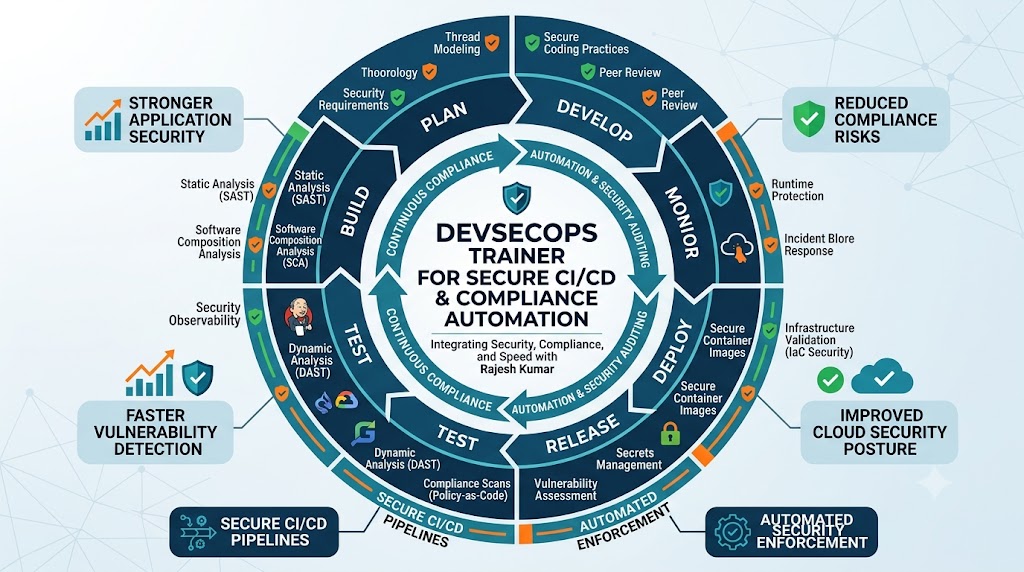
In traditional software delivery, security is often added at the end of the release cycle. DevSecOps changes this model by integrating security throughout the pipeline.
A secure CI/CD pipeline includes:
- Code analysis during development
- Dependency vulnerability scanning
- Automated testing for security issues
- Container image scanning
- Infrastructure security validation
This ensures that vulnerabilities are detected early, reducing risk and remediation costs.
DevSecOps Trainer for Secure Software Delivery
A DevSecOps Trainer focuses on practical, hands-on security integration within DevOps workflows.
Key training areas include:
- Secure pipeline design and implementation
- Static and dynamic application security testing (SAST/DAST)
- Secrets management and encryption
- Identity and access management (IAM)
- Security automation in CI/CD systems
This training helps engineering teams build secure systems without slowing down delivery speed.
DevSecOps Corporate Training for Enterprises
Enterprise environments require consistent security practices across multiple teams and platforms. DevSecOps Corporate Training helps standardize these practices.
It includes:
- Organization-wide security policies
- Secure development lifecycle (SDLC) practices
- Compliance-driven automation workflows
- Security governance in cloud environments
- Risk management and mitigation strategies
This ensures security becomes a shared responsibility across development, operations, and security teams.
Compliance Automation in DevSecOps
Compliance is a major challenge in regulated industries such as finance, healthcare, and enterprise IT.
DevSecOps introduces automation into compliance processes:
- Policy-as-code enforcement
- Automated compliance checks in pipelines
- Audit-ready logging and reporting
- Continuous compliance monitoring
- Infrastructure configuration validation
This reduces manual effort while ensuring regulatory requirements are consistently met.
DevSecOps in Cloud and Kubernetes Environments
Cloud-native environments and Kubernetes clusters introduce new security challenges.
A DevSecOps approach ensures:
- Secure container image management
- Kubernetes RBAC and network policies
- Secure API access controls
- Cloud infrastructure hardening
- Runtime security monitoring
These practices help protect distributed systems running in dynamic cloud environments.
DevOps and DevSecOps Integration
DevSecOps extends DevOps principles by embedding security into automation workflows.
While DevOps focuses on:
- Speed
- Automation
- Collaboration
DevSecOps adds:
- Security validation
- Risk prevention
- Compliance enforcement
- Continuous security monitoring
Together, they ensure fast and secure software delivery.
Tools and Technologies Covered
| Area | Tools / Topics | Business Value |
|---|---|---|
| CI/CD Security | Jenkins Training | Secure automated pipelines |
| Code Security | SAST/DAST Tools | Early vulnerability detection |
| Containers | Docker Kubernetes Training | Secure containerized workloads |
| Cloud | AWS DevOps | Secure cloud infrastructure |
| Infrastructure | Terraform Training | Secure infrastructure automation |
| Monitoring | Security Observability | Threat detection and response |
| Compliance | Policy as Code | Automated regulatory compliance |
| Secrets Management | Vault, KMS | Secure credential handling |
| DevOps | CI/CD Pipeline Training | Reliable and secure delivery |
| Security | DevSecOps Practices | End-to-end application security |
Why Choose DevSecOps Training
Organizations invest in DevSecOps training because it delivers:
- Stronger application security
- Faster vulnerability detection
- Reduced compliance risks
- Secure CI/CD pipelines
- Better cloud security posture
- Automated security enforcement
- Improved developer awareness
- Reduced production incidents
It ensures security is built into the system, not added later.
Best Fit Audience
DevSecOps training is ideal for:
- DevOps engineers
- Software developers
- Security engineers
- Cloud engineers
- Platform engineering teams
- SRE teams
- IT compliance teams
- Enterprise architecture teams
It is especially valuable for organizations handling sensitive data or regulated workloads.
Business Benefits of DevSecOps Training
Organizations adopting DevSecOps practices experience:
- Reduced security vulnerabilities
- Faster and safer software delivery
- Improved compliance readiness
- Better cloud security posture
- Lower risk of data breaches
- Stronger audit readiness
- Increased developer security awareness
- Improved operational confidence
These benefits directly improve business resilience and trust.
FAQs
Why is a DevSecOps Trainer important?
A DevSecOps Trainer helps teams integrate security into CI/CD pipelines and automate compliance processes.
What is DevSecOps in simple terms?
DevSecOps means adding security practices into every stage of software development and deployment.
Who should attend DevSecOps Corporate Training?
Developers, DevOps engineers, cloud engineers, and security teams should attend.
How does DevSecOps improve CI/CD pipelines?
It adds automated security checks, vulnerability scanning, and compliance validation into pipelines.
Is DevSecOps necessary for cloud systems?
Yes, it is essential for securing cloud-native and Kubernetes-based environments.
Conclusion
As software delivery becomes faster and more automated, security cannot remain an afterthought. DevSecOps ensures that security, compliance, and automation work together across the entire development lifecycle.
An experienced DevSecOps Trainer helps organizations build secure CI/CD pipelines, automate compliance, and strengthen cloud-native security practices.
Organizations looking to enhance their security and delivery maturity can explore expert training and consulting at:
https://www.rajeshkumar.xyz/
With the right DevSecOps approach, teams can deliver software that is not only fast and scalable but also secure and compliant by design.
