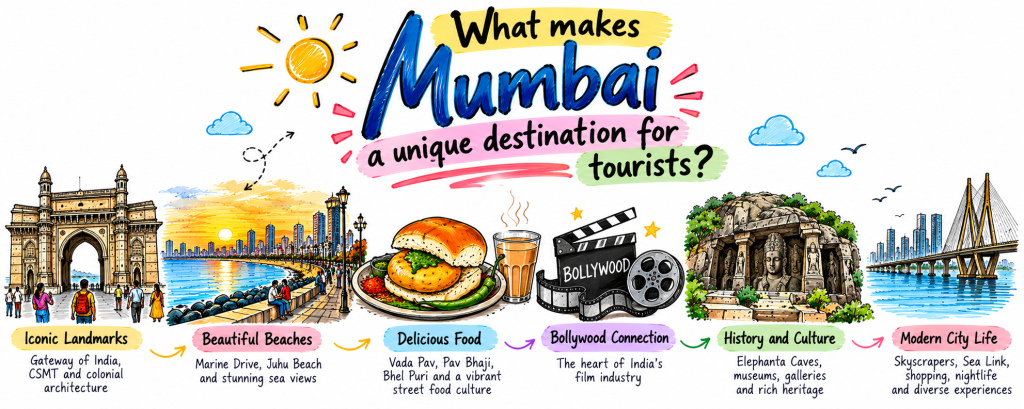
Mumbai is one of India’s most distinctive travel destinations.
The city combines history, beaches, architecture, food, entertainment, religion, art, business, and everyday city life in one place.
A visitor can explore a historic railway station in the morning, walk beside the Arabian Sea in the afternoon, visit a heritage market, enjoy local street food, and watch the city light up at night.
That mix gives Mumbai its special character.
The city was once a group of seven islands. Over time, those islands developed into a major metropolitan centre. Maharashtra Tourism describes Mumbai as a financial, cultural, industrial, and entertainment centre with a rich historical background and diverse culture.
Mumbai also offers different experiences within a relatively compact urban region.
Travellers can explore South Mumbai for heritage and architecture.
They can visit the western suburbs for beaches and entertainment.
They can head north for nature and ancient caves.
They can also experience religious sites, local markets, museums, art spaces, and neighbourhood food.
This variety makes Mumbai more than a city for business trips.
It gives tourists many reasons to stay and explore.
Why Is Mumbai Different From Other Indian Cities?
Mumbai has a combination that is difficult to find in one destination.
The city has:
- A long coastal setting
- Historic architecture
- Colonial-era landmarks
- Religious sites
- UNESCO World Heritage Sites
- Beaches
- Museums
- Street food
- Bollywood connections
- Art and cultural spaces
- Large public parks
- Ancient caves
- Modern infrastructure
- Busy markets
- Diverse neighbourhoods
A tourist can therefore create very different Mumbai itineraries.
One visitor may focus on history.
Another may focus on food.
Someone else may want beaches and nightlife.
A family may prefer parks, museums, and sightseeing.
A history lover may spend hours exploring heritage buildings.
The city can support all of these travel styles.
1. Mumbai’s Unique History Gives the City Character
Mumbai’s history is one of the main reasons the city feels different.
The present-day city developed from a group of seven islands.
Over centuries, the area went through major political, commercial, and urban changes.
Maharashtra Tourism notes that Mumbai’s history stretches back more than 2,000 years and that the city later became an important commercial and cultural centre.
You can still see different periods of this history across the city.
Historic railway stations stand beside modern offices.
Old markets operate near modern shopping areas.
Colonial buildings stand alongside contemporary structures.
Ancient caves exist within the wider metropolitan region.
This mixture makes sightseeing more interesting.
2. The Gateway of India Represents Mumbai’s Heritage
The Gateway of India is one of Mumbai’s best-known landmarks.
The monument stands beside the Arabian Sea in South Mumbai.
It was built in 1924 and is connected with Mumbai’s colonial-era history. Maharashtra Tourism describes it as an iconic waterfront monument and a major tourist attraction.
The location also gives visitors access to the waterfront.
Travellers can spend time around the monument before exploring nearby areas.
The Gateway also acts as a starting point for trips toward Elephanta Island.
This makes it both a sightseeing landmark and an important part of the city’s tourism experience.
3. Chhatrapati Shivaji Maharaj Terminus Shows Mumbai’s Architecture
Mumbai is not only about modern skyscrapers.
The city has remarkable historic architecture.
Chhatrapati Shivaji Maharaj Terminus, commonly known as CSMT, is one of the clearest examples.
Maharashtra Tourism identifies the station as a UNESCO World Heritage Site and describes its architecture as a combination of Victorian Gothic Revival and Indian influences.
The building is still a functioning railway station.
That makes the experience different from visiting a monument that exists only for tourists.
Visitors can see historic architecture while watching one of Mumbai’s busiest transport areas operate around it.
4. Marine Drive Gives Mumbai Its Coastal Identity
Marine Drive is another defining part of the city.
The curved road runs along the Arabian Sea.
Its line of lights creates the famous nickname “Queen’s Necklace.”
Maharashtra Tourism highlights Marine Drive as a popular place for walks, sunsets, sea views, and relaxation.
A visit does not require a complicated plan.
You can simply walk along the promenade.
Sit and watch the sea.
Take photographs.
Enjoy the evening breeze.
Or watch Mumbai’s skyline after sunset.
This simple experience is one reason Marine Drive remains important to visitors.
5. Mumbai Offers Ancient History Alongside Modern City Life
One of Mumbai’s most interesting qualities is the contrast between old and new.
You can find ancient rock-cut architecture within the same metropolitan region that contains corporate offices, shopping centres, railway networks, and modern residential areas.
The Elephanta Caves are an important example.
The caves are located on Elephanta Island in Mumbai Harbour.
Maharashtra Tourism identifies them as a UNESCO World Heritage Site and highlights their rock-cut architecture and famous Shiva sculptures.
The journey itself adds to the experience.
Visitors travel by ferry from the Gateway of India to the island.
Maharashtra Tourism says the ferry journey takes roughly an hour.
So one experience combines:
Mumbai harbour + sea journey + island landscape + ancient architecture + cultural history.
That combination is unusual within a major modern city.
6. Elephanta Caves Add a Cultural Dimension
The Elephanta Caves are not simply another sightseeing location.
They represent India’s ancient rock-cut architectural tradition.
The main cave contains important sculptures associated with Shiva.
The famous Trimurti sculpture is one of the site’s best-known features.
The caves were carved into basalt rock and contain pillars, sculptures, and temple spaces. Maharashtra Tourism notes their historical and architectural importance and their UNESCO recognition.
For tourists interested in history, architecture, and religion, Elephanta can become one of the most memorable parts of a Mumbai trip.
7. Mumbai Has Religious Diversity
Mumbai’s tourism experience also includes important religious places.
The city has Hindu temples, Islamic shrines, churches, and other religious landmarks.
Among the well-known sites are:
- Haji Ali Dargah
- Siddhivinayak Temple
- Mahalakshmi Temple
- Mount Mary Basilica
- Other local temples and places of worship
Haji Ali Dargah is located on an islet in the Arabian Sea and is known for its Indo-Islamic architecture. Maharashtra Tourism lists it among Mumbai’s important religious attractions.
Siddhivinayak Temple is another important landmark.
The temple is dedicated to Lord Ganesha and dates back to 1801, with later modifications.
These places show how religion remains part of everyday city life.
8. Mumbai’s Street Food Makes the City Special
Food is one of the easiest ways to experience Mumbai.
The city has a famous street-food culture.
Some well-known foods include:
- Vada pav
- Pav bhaji
- Bhel puri
- Sev puri
- Pani puri
- Bombil fry
- Misal pav
- Kebabs
- Regional Maharashtrian dishes
Maharashtra Tourism specifically highlights vada pav, pav bhaji, Bombil fry, bhel puri, pani puri, and sev puri among Mumbai’s popular foods.
The food experience is not limited to restaurants.
Street stalls, local markets, small cafés, and neighbourhood eateries all contribute to Mumbai’s food culture.
9. Vada Pav Represents Mumbai’s Everyday Food Culture
Vada pav is strongly associated with Mumbai.
It is simple.
It is affordable.
It is easy to eat while travelling.
A typical vada pav includes a potato fritter served inside a pav with chutneys and spices.
For visitors, trying local street food can be more than just eating.
It provides a glimpse into everyday Mumbai.
However, tourists should choose clean and busy food stalls and take normal precautions when trying unfamiliar food.
10. Mumbai Is Closely Connected With Indian Cinema
Mumbai has a major connection with India’s Hindi film industry.
This has given the city a special place in popular culture.
Visitors can explore areas connected with the film industry and look for cinema-related experiences.
Maharashtra Tourism lists Mumbai Film City among attractions in the Mumbai suburban district and describes it as a major location associated with Bollywood film production.
For film fans, this adds another layer to a Mumbai visit.
The city is not just a place where films are watched.
It is also a place where a large part of India’s film industry operates.
11. Beaches Add Another Side to Mumbai
Mumbai is a major urban centre.
Yet it also has several beaches.
Important examples include:
- Juhu Beach
- Girgaum Chowpatty
- Versova Beach
- Aksa Beach
- Gorai Beach
Juhu Beach is one of Mumbai’s best-known beaches and is listed by Maharashtra Tourism as a major attraction in the suburban district.
Beaches can be useful for travellers who want a relaxed break between city attractions.
You can watch the sunset, walk along the shore, try local snacks, or simply spend time near the sea.
12. Sanjay Gandhi National Park Makes Mumbai Even More Unusual
One of Mumbai’s most interesting features is the presence of a major protected natural area within the metropolitan region.
Sanjay Gandhi National Park offers forests, wildlife, biodiversity, and historical sites.
Maharashtra Tourism describes the park as a large green area within the city and notes that it covers about 87 square kilometres.
The department also lists more than 1,300 plant species, 274 bird species, 35 mammal species, and 170 butterfly species for the park.
This creates a strong contrast.
One part of Mumbai can feel intensely urban.
Another part can feel much more natural.
13. Kanheri Caves Add History to the National Park
Sanjay Gandhi National Park is not only about greenery.
The park also contains the ancient Kanheri Caves.
These rock-cut Buddhist monuments provide another connection with Mumbai’s historic past.
Maharashtra Tourism describes the Kanheri Caves as ancient Buddhist monuments located within the park.
This combination is particularly interesting for tourists.
You can experience:
Forest → caves → ancient history → wildlife → modern Mumbai
within one broader destination.
14. Mumbai Has a Strong Museum and Art Scene
Tourists who enjoy museums and art can explore several cultural institutions.
Maharashtra Tourism lists museums and galleries including:
- Chhatrapati Shivaji Maharaj Vastu Sangrahalaya
- Bhau Daji Lad Museum
- Jehangir Art Gallery
- Other cultural institutions
The Chhatrapati Shivaji Maharaj Vastu Sangrahalaya houses collections covering archaeology, art, natural history, and anthropology. Maharashtra Tourism describes the museum as an important cultural institution in Mumbai.
This gives visitors an option beyond outdoor sightseeing.
A museum visit can also be useful during hot afternoons or periods of heavy rain.
15. Mumbai’s Architecture Is a Tourist Experience
Mumbai’s architecture deserves attention.
Different areas show different architectural influences.
Visitors can find:
- Victorian Gothic buildings
- Indo-Saracenic architecture
- Art Deco buildings
- Colonial structures
- Religious architecture
- Modern skyscrapers
This variety makes walking tours particularly interesting.
You do not always need to enter a building.
Sometimes the streets themselves become the attraction.
16. Mumbai’s Art Deco Heritage Adds Another Layer
The city is also known for its Art Deco architecture.
Visitors exploring South Mumbai can notice Art Deco buildings around areas such as Marine Drive and nearby neighbourhoods.
The buildings provide a visual connection between Mumbai’s colonial past and its modern urban development.
For architecture lovers, this can become an important part of a Mumbai itinerary.
17. Colaba Offers History, Shopping, and Local Energy
Colaba is one of the most popular areas for tourists.
The neighbourhood provides access to major landmarks and shopping areas.
Visitors can explore:
- Gateway of India
- Colaba Causeway
- Heritage buildings
- Cafés
- Restaurants
- Shops
- Street markets
Maharashtra Tourism specifically highlights Colaba Causeway as a lively shopping area with handicrafts, jewellery, clothing, and souvenirs.
This makes Colaba useful for travellers who want to combine sightseeing and shopping.
18. Mumbai’s Markets Show Everyday City Life
Markets provide a different view of the city.
Tourists can explore places such as:
- Crawford Market area
- Colaba Causeway
- Chor Bazaar
- Dadar flower market
- Local neighbourhood markets
Markets can be busy.
They can also be crowded.
But they offer a closer look at everyday commerce.
Travellers can observe local products, food, clothing, flowers, household goods, and traditional items.
19. Mumbai’s Local Trains Are Part of the City’s Identity
Mumbai’s railway system is not simply a transportation network.
It is closely connected with daily life in the city.
The suburban railway helps millions of people travel across the metropolitan region.
For tourists, the system can also provide insight into how the city functions.
However, visitors unfamiliar with the network should plan carefully.
Avoid peak-hour travel when possible if you are carrying luggage or travelling with young children.
20. The Bandra-Worli Sea Link Represents Modern Mumbai
Mumbai is not only historic.
It also represents modern infrastructure.
The Bandra-Worli Sea Link is one of the city’s recognisable modern landmarks.
Maharashtra Tourism describes the bridge as an eight-lane cable-stayed structure connecting Bandra and Worli across the sea.
The structure has become part of Mumbai’s modern skyline.
It represents the city’s continuing growth.
21. Mumbai Gives Tourists Different Experiences in One Trip
A visitor can build a Mumbai trip around many themes.
| Travel Interest | Mumbai Experience |
|---|---|
| History | Gateway of India, CSMT, Elephanta Caves |
| Architecture | CSMT, Art Deco areas, heritage buildings |
| Nature | Sanjay Gandhi National Park |
| Beaches | Marine Drive, Juhu Beach, Chowpatty |
| Food | Vada pav, pav bhaji, chaat |
| Religion | Haji Ali, Siddhivinayak, Mahalakshmi |
| Art | Museums and galleries |
| Cinema | Film City and Bollywood-related experiences |
| Shopping | Colaba Causeway and local markets |
| Photography | Marine Drive, heritage areas, markets |
| Family travel | Parks, museums, beaches |
| Cultural travel | Festivals, heritage sites, performances |
This variety is one of the city’s biggest tourism strengths.
22. Mumbai Is a Good Destination for Short Trips
Travellers do not necessarily need a long holiday to experience Mumbai.
A 3-day trip can cover several major areas.
Day 1 – South Mumbai
- Gateway of India
- Colaba
- CSMT
- Museum
- Marine Drive
Day 2 – Culture and Local Life
- Religious landmark
- Market
- Food experience
- Heritage walk
Day 3 – Nature or Suburbs
- Sanjay Gandhi National Park
- Kanheri Caves
- Juhu Beach
- Bandra area
The exact schedule should depend on traffic, opening hours, and attraction availability.
23. Mumbai for Families
Families can choose a mixture of easy sightseeing and recreational activities.
Possible options include:
- Marine Drive
- Juhu Beach
- Museums
- Parks
- Gateway of India
- Sanjay Gandhi National Park
- Kanheri Caves
Parents should consider travel time between locations.
Mumbai traffic can make a tightly packed itinerary tiring.
A better plan uses fewer locations each day.
24. Mumbai for Couples
Couples can create a relaxed itinerary around the city’s coastal and cultural experiences.
A possible day might include:
Morning: Museum or heritage attraction
Afternoon: Café and local shopping
Evening: Marine Drive
Night: Dinner
Another day can include:
Gateway of India → Colaba → sunset → evening meal
The city offers plenty of options without requiring a rigid schedule.
25. Mumbai for Solo Travellers
Solo travellers can explore Mumbai through walking routes, museums, food experiences, markets, and public attractions.
A solo itinerary can include:
- Heritage walks
- Museums
- Marine Drive
- Local markets
- Cafés
- Art galleries
- Historical monuments
Solo travellers should still use normal city safety practices.
Keep valuables secure.
Be careful in crowded places.
Plan late-night transport in advance.
26. Mumbai for Food Lovers
Food lovers can spend an entire trip exploring the city’s culinary identity.
A food-focused itinerary might include:
Breakfast
Local Maharashtrian or South Indian breakfast.
Afternoon
Traditional meal or restaurant experience.
Evening
Street food.
Night
Dessert or café.
Mumbai’s food culture also reflects its diverse population.
You can find Maharashtrian food alongside Gujarati, South Indian, North Indian, Parsi, coastal, and international cuisines.
27. Mumbai for History Lovers
History lovers have many choices.
A possible itinerary includes:
Day 1
Gateway of India
CSMT
Heritage architecture
Day 2
Elephanta Caves
Museum
Day 3
Kanheri Caves
Sanjay Gandhi National Park
This itinerary connects different historical periods.
28. Mumbai for Nature Lovers
Nature may not be the first thing people associate with Mumbai.
Yet the city offers several natural spaces.
Visitors can explore:
- Sanjay Gandhi National Park
- Marine Drive
- Juhu Beach
- Aksa Beach
- Gorai
- Other coastal areas
The presence of Sanjay Gandhi National Park makes the city especially interesting for travellers who want some greenery during an urban holiday.
29. Mumbai During the Monsoon
Mumbai’s monsoon changes the city’s atmosphere.
Rain can create challenges.
But it also changes the look of the city.
Green areas become more vibrant.
Waterfalls and nearby natural areas can become attractive.
Maharashtra Tourism notes that June to September brings heavy monsoon rainfall and that this period can suit travellers interested in greenery and waterfalls.
However, tourists should plan carefully during heavy rain.
Allow extra travel time.
Carry rain protection.
Check local weather conditions.
30. Mumbai During Winter
October to February is generally a comfortable period for sightseeing.
Maharashtra Tourism lists October to February as the best period for sightseeing in Mumbai because of more pleasant weather.
This period can work well for:
- Heritage walks
- Beach visits
- Outdoor sightseeing
- Photography
- City tours
- Day trips
31. How Many Days Are Enough for Mumbai?
Maharashtra Tourism lists an ideal duration of around 3–5 days for Mumbai.
A simple guide is:
| Trip Length | Suggested Focus |
|---|---|
| 1 Day | Gateway of India + Colaba + Marine Drive |
| 2 Days | Add CSMT, museum, markets |
| 3 Days | Add Elephanta or suburban attractions |
| 4 Days | Add Sanjay Gandhi National Park or beaches |
| 5 Days | Explore at a slower pace |
Longer stays allow travellers to explore neighbourhoods rather than only major attractions.
32. How to Plan a Mumbai Trip Efficiently
Mumbai is a large city.
Travel time matters.
Instead of crossing the entire city several times a day, group nearby attractions.
For example:
South Mumbai Day
Gateway of India
Colaba
Museum
CSMT
Marine Drive
Central or Suburban Day
Markets
Temples
Bandra
Juhu
North Mumbai Day
Sanjay Gandhi National Park
Kanheri Caves
This approach reduces unnecessary travel.
33. Why Mumbai Appeals to Different Types of Tourists
Mumbai does not depend on one type of attraction.
That is important.
A destination can become difficult for some travellers if its tourism depends mainly on one attraction.
Mumbai offers many alternatives.
If you do not enjoy museums, you can visit beaches.
If you do not enjoy beaches, you can explore heritage areas.
If you do not enjoy shopping, you can explore food.
If you do not enjoy crowded areas, you can spend time in parks.
If you love history, there are caves and monuments.
This flexibility makes the city suitable for many travel styles.
34. Mumbai’s Biggest Attraction Is Its Variety
The most interesting thing about Mumbai may not be one specific monument.
It is the combination.
Think about one possible day:
Morning
Explore a historic building.
Afternoon
Visit a museum.
Evening
Walk along Marine Drive.
Night
Try local street food.
Four different experiences can happen in one day.
That variety is what makes Mumbai memorable.
35. Practical Tips for First-Time Visitors
Plan Around Geography
Group nearby attractions.
Avoid Overloading the Day
Mumbai travel can take longer than expected.
Start Early
Morning sightseeing can be more comfortable.
Keep Some Flexibility
Traffic and weather can change plans.
Carry Water
Walking around the city can become tiring.
Wear Comfortable Shoes
Many attractions involve walking.
Check Timings
Museums, caves, religious sites, and attractions may have different schedules.
Keep Cash and Digital Payment Options
Some small vendors may prefer one payment method over another.
Respect Religious Places
Follow local dress and photography rules.
36. What Makes Mumbai a Unique Tourist Destination?
Mumbai stands out because it combines several identities.
It is:
A historic city
A financial centre
A coastal destination
A cultural centre
A film city
A food destination
A religious destination
A modern metropolis
A nature destination
A heritage destination
These identities exist together.
That is why two visitors can have completely different experiences in Mumbai.
One may remember Marine Drive.
Another may remember Elephanta.
Someone else may remember street food.
A history lover may remember CSMT.
A nature lover may remember Sanjay Gandhi National Park.
A film fan may remember Mumbai’s cinema connection.
All of these experiences belong to the same city.
37. Final Thoughts
Mumbai is unique because it does not fit into one simple tourism category.
It combines the old and the new.
It combines the sea with a dense urban landscape.
It combines historic monuments with modern infrastructure.
It combines religious traditions with contemporary culture.
It combines street food with restaurants and cafés.
It combines ancient caves with modern entertainment.
The Gateway of India, Marine Drive, CSMT, Elephanta Caves, Haji Ali, museums, beaches, markets, and Sanjay Gandhi National Park each show a different side of the city. Maharashtra Tourism’s official Mumbai information highlights this combination of history, heritage, coastline, culture, food, religion, entertainment, and nature.
For a first visit, travellers can focus on South Mumbai and then add one or two experiences outside the central heritage area.
For a longer stay, they can explore beaches, caves, parks, museums, markets, and neighbourhoods at a slower pace.
The most important thing is not to rush.
Mumbai has many layers.
Give yourself time to notice them.
Explore its landmarks.
Taste its food.
Walk beside the sea.
Look at its architecture.
Visit its historic sites.
Spend time in its neighbourhoods.
That is when Mumbai becomes more than a list of tourist attractions.
It becomes a city experience.
Frequently Asked Questions
What makes Mumbai unique for tourists?
Mumbai combines history, beaches, architecture, food, religion, entertainment, museums, ancient caves, modern infrastructure, and diverse neighbourhoods in one metropolitan destination.
How many days are enough for Mumbai?
Three to five days can provide a good introduction to the city. Maharashtra Tourism also lists 3–5 days as an ideal duration.
What is Mumbai most famous for?
Mumbai is widely known for its financial importance, Bollywood connection, coastline, historic landmarks, street food, and vibrant urban culture.
What are the most important tourist attractions in Mumbai?
Major attractions include the Gateway of India, Marine Drive, CSMT, Elephanta Caves, Haji Ali Dargah, Siddhivinayak Temple, Juhu Beach, and Sanjay Gandhi National Park.
Is Mumbai good for history lovers?
Yes. Travellers can explore CSMT, Gateway of India, Elephanta Caves, Kanheri Caves, museums, and historic neighbourhoods.
Is Mumbai suitable for families?
Yes. Families can combine parks, museums, beaches, heritage attractions, and nature experiences.
What food should tourists try in Mumbai?
Popular choices include vada pav, pav bhaji, bhel puri, sev puri, pani puri, Bombil fry, and other regional dishes.
Can tourists visit Elephanta Caves from Mumbai?
Yes. Visitors can take a ferry from the Gateway of India to Elephanta Island. Maharashtra Tourism says the journey takes roughly an hour.
Is Mumbai only suitable for urban sightseeing?
No. Visitors can also explore beaches, Sanjay Gandhi National Park, Kanheri Caves, and other natural areas.
What is the best time to visit Mumbai?
Maharashtra Tourism recommends October to February for sightseeing because the weather is generally more pleasant.
Is Marine Drive worth visiting?
Marine Drive is one of Mumbai’s iconic coastal locations and is especially popular for walks, sea views, sunsets, and evening atmosphere.
What makes Mumbai different from other Indian cities?
Its combination of coastal scenery, historic architecture, financial activity, cinema, food, religious diversity, cultural institutions, and urban energy creates a distinctive travel experience.
#MumbaiTourism #MumbaiTravel #VisitMumbai #ExploreMumbai #MumbaiTouristPlaces #MumbaiTravelGuid #MaharashtraTourism #MumbaiHeritage #MumbaiFood #MumbaiBeaches
