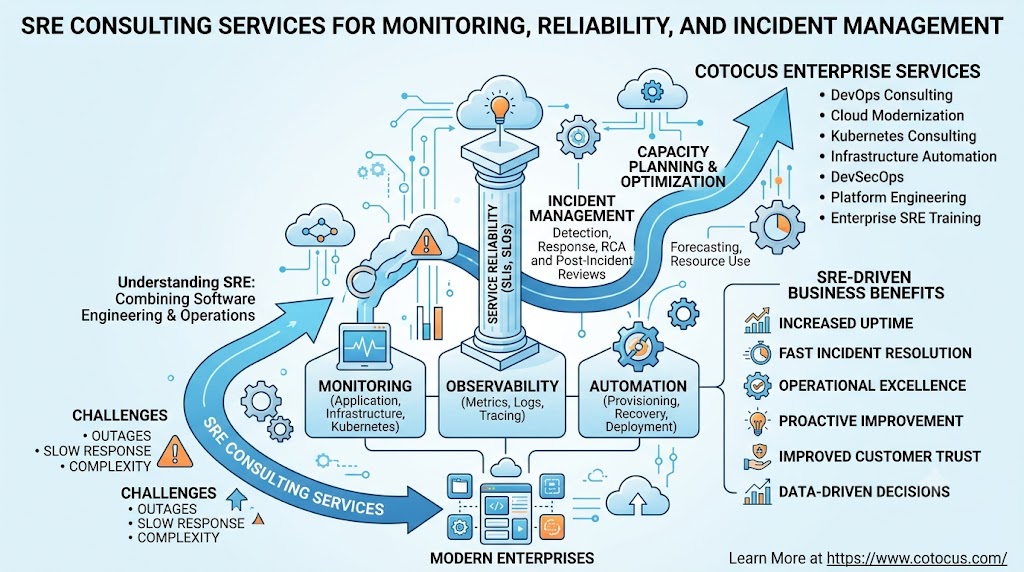
Introduction
Modern enterprises depend on digital applications to deliver products, support customers, and maintain business continuity. As applications become more distributed across cloud environments, Kubernetes clusters, microservices, and hybrid infrastructure, maintaining consistent performance and availability becomes increasingly challenging. Even small service disruptions can lead to lost revenue, reduced customer trust, and operational inefficiencies. This is where SRE Consulting Services provide significant value.
Site Reliability Engineering (SRE) combines software engineering principles with IT operations to improve system reliability, automate operational tasks, strengthen monitoring, and streamline incident management. Rather than reacting to problems after they occur, SRE helps organizations build resilient platforms that detect, prevent, and recover from failures efficiently.
Cotocus provides enterprise SRE consulting services alongside DevOps consulting, cloud modernization, Kubernetes consulting, DevSecOps implementation, infrastructure automation, platform engineering, CI/CD optimization, AIOps consulting, and corporate training. Organizations seeking to improve application reliability and operational excellence can learn more by visiting https://www.cotocus.com/.
Why Modern Enterprises Need SRE Consulting Services
Today’s enterprise applications are expected to be available around the clock while supporting thousands or even millions of users. Traditional operational practices often struggle to keep pace with modern distributed systems.
Organizations commonly experience challenges such as:
- Unexpected production outages
- Slow incident response
- Limited monitoring visibility
- Performance bottlenecks
- Manual operational processes
- Increasing infrastructure complexity
- Difficulty maintaining service availability
- Lack of standardized operational practices
- Reactive troubleshooting
SRE consulting helps organizations address these challenges through automation, observability, reliability engineering, and continuous operational improvement.
Understanding Site Reliability Engineering
Site Reliability Engineering focuses on building highly reliable systems by combining software development expertise with operational best practices.
Rather than relying solely on manual system administration, SRE introduces engineering-driven automation and measurable reliability objectives.
Core SRE principles include:
- Service reliability
- Automation
- Monitoring
- Observability
- Incident management
- Capacity planning
- Continuous improvement
- Performance optimization
- Operational excellence
These practices help organizations deliver stable and predictable digital services.
Monitoring as the Foundation of Reliability
Reliable systems begin with comprehensive monitoring.
Monitoring provides continuous visibility into application performance, infrastructure health, and user experience, allowing engineering teams to identify potential issues before they affect business operations.
SRE consulting helps organizations implement monitoring for:
- Application performance
- Infrastructure resources
- Containers and Kubernetes
- Network health
- Database performance
- Cloud services
- Business transactions
- Security events
A well-designed monitoring strategy enables faster detection and resolution of operational issues.
Building Effective Observability
Monitoring provides metrics, while observability helps teams understand why problems occur.
Modern observability includes:
Metrics
Real-time performance indicators that measure system behavior and resource utilization.
Logs
Detailed operational records used for troubleshooting and auditing.
Distributed Tracing
Tracing requests across microservices to identify latency and application bottlenecks.
Alerting
Intelligent alerting ensures engineering teams receive actionable notifications without excessive noise.
Observability provides deeper operational insight into increasingly complex cloud-native environments.
Service Level Indicators and Objectives
One of the defining characteristics of SRE is the use of measurable service targets.
Service Level Indicators (SLIs)
SLIs measure important aspects of service performance, including:
- Availability
- Response time
- Error rate
- Throughput
Service Level Objectives (SLOs)
SLOs establish measurable reliability goals that align technical performance with business expectations.
Using SLIs and SLOs helps organizations make informed operational decisions while maintaining service quality.
Incident Management
Even well-designed systems experience occasional failures.
SRE consulting improves incident management through structured processes that reduce downtime and accelerate recovery.
Key areas include:
- Incident detection
- Alert management
- Response coordination
- Root cause analysis
- Post-incident reviews
- Knowledge documentation
- Continuous improvement
Well-defined incident management processes minimize business disruption and improve customer satisfaction.
Automation for Operational Excellence
Automation is central to Site Reliability Engineering.
SRE consulting helps organizations automate repetitive operational tasks such as:
- Infrastructure provisioning
- Application deployment
- Monitoring configuration
- Health checks
- Backup operations
- Scaling
- Recovery procedures
- Compliance validation
Automation reduces manual errors while improving consistency and operational efficiency.
Capacity Planning and Performance Optimization
Reliable systems require sufficient capacity to support business growth.
SRE consulting helps organizations:
- Forecast resource demand
- Optimize infrastructure utilization
- Improve workload distribution
- Prevent resource bottlenecks
- Support cloud scalability
- Enhance application performance
Proactive capacity planning reduces operational risks while supporting long-term growth.
DevOps and SRE Working Together
DevOps and Site Reliability Engineering complement one another by improving both software delivery and operational reliability.
Together they enable:
- Continuous Integration
- Continuous Delivery
- Infrastructure as Code
- Automated deployments
- Monitoring integration
- Operational automation
- Faster software releases
- Stable production environments
This combination creates a balanced approach to speed, reliability, and quality.
Kubernetes Reliability
Many modern applications operate on Kubernetes platforms that require continuous monitoring and operational optimization.
SRE consulting supports Kubernetes through:
- Cluster monitoring
- Resource optimization
- Workload health monitoring
- Autoscaling strategies
- Failure recovery
- Security monitoring
- High availability design
Reliable Kubernetes environments improve application performance while simplifying operations.
DevSecOps and Reliability
Security contributes directly to operational reliability.
SRE consulting often integrates DevSecOps practices including:
- Security monitoring
- Vulnerability management
- Compliance validation
- Secrets management
- Identity management
- Secure automation
- Continuous risk assessment
Secure systems experience fewer disruptions while maintaining regulatory compliance.
Platform Engineering and Developer Productivity
Platform engineering supports SRE by creating standardized environments that simplify software delivery.
Benefits include:
- Self-service infrastructure
- Standardized deployment platforms
- Consistent monitoring
- Automated provisioning
- Improved governance
- Better developer experience
These platforms reduce operational complexity while improving engineering productivity.
Enterprise SRE Training
Technology transformation depends on knowledgeable engineering teams.
Enterprise SRE training often includes:
- Reliability engineering principles
- Monitoring strategies
- Observability
- Incident management
- Kubernetes operations
- Automation
- DevOps integration
- Capacity planning
- Performance tuning
- Operational best practices
Hands-on training prepares teams to manage modern production environments confidently.
Business Benefits of SRE Consulting Services
Organizations implementing Site Reliability Engineering often achieve measurable operational improvements.
| Traditional IT Operations | SRE-Driven Operations |
|---|---|
| Reactive issue management | Proactive reliability engineering |
| Manual monitoring | Intelligent observability |
| Slow incident response | Structured incident management |
| Limited automation | Automated operational workflows |
| Inconsistent reliability | Measurable SLIs and SLOs |
| Manual capacity planning | Data-driven forecasting |
| Frequent operational interruptions | Improved production stability |
| Separate development and operations | DevOps and SRE collaboration |
| Limited operational visibility | Real-time monitoring and analytics |
Why Enterprises Choose Cotocus
Building highly reliable digital platforms requires technical expertise, practical implementation experience, and a structured operational strategy.
Cotocus helps organizations improve monitoring, reliability, automation, and incident management through enterprise SRE consulting services. By combining Site Reliability Engineering with DevOps, Kubernetes, infrastructure automation, DevSecOps, platform engineering, cloud consulting, and corporate training, Cotocus enables businesses to create resilient technology environments that support continuous innovation and long-term operational excellence.
Frequently Asked Questions
What are SRE Consulting Services?
SRE Consulting Services help organizations improve application reliability through monitoring, observability, automation, incident management, capacity planning, and operational best practices.
What is Site Reliability Engineering?
Site Reliability Engineering applies software engineering principles to IT operations to improve system availability, scalability, automation, and operational efficiency.
Why is monitoring important?
Monitoring provides real-time visibility into applications and infrastructure, allowing teams to detect issues early and maintain service performance.
What is observability?
Observability combines metrics, logs, traces, and alerting to help engineering teams understand the behavior of complex distributed systems.
What are SLIs and SLOs?
Service Level Indicators measure system performance, while Service Level Objectives define target reliability levels aligned with business requirements.
How does SRE improve incident management?
SRE establishes structured processes for detecting, responding to, analyzing, and preventing production incidents, reducing downtime and improving service stability.
How does automation support reliability?
Automation reduces manual operational tasks, improves consistency, accelerates recovery, and minimizes human error across production environments.
Does SRE work with Kubernetes?
Yes. SRE practices improve Kubernetes reliability through monitoring, resource optimization, autoscaling, observability, and operational automation.
How does SRE complement DevOps?
DevOps accelerates software delivery, while SRE ensures production systems remain reliable, scalable, and operationally efficient after deployment.
Why choose Cotocus for SRE consulting?
Cotocus combines expertise in Site Reliability Engineering, DevOps, Kubernetes, infrastructure automation, DevSecOps, platform engineering, cloud consulting, and enterprise training to help organizations build reliable, scalable, and resilient digital platforms.
Conclusion
SRE Consulting Services help enterprises strengthen monitoring, improve system reliability, streamline incident management, and automate operational processes for modern cloud-native environments. By integrating Site Reliability Engineering with DevOps, Kubernetes, infrastructure automation, DevSecOps, and platform engineering, organizations can build resilient technology platforms that support continuous business operations and long-term digital growth.
Cotocus partners with enterprises to deliver practical SRE consulting, implementation support, and corporate training that enhance operational excellence and business resilience. Whether your organization is improving production stability, modernizing monitoring capabilities, or implementing proactive reliability practices, https://www.cotocus.com/ offers the consulting expertise and enterprise services needed to achieve sustainable operational success.
