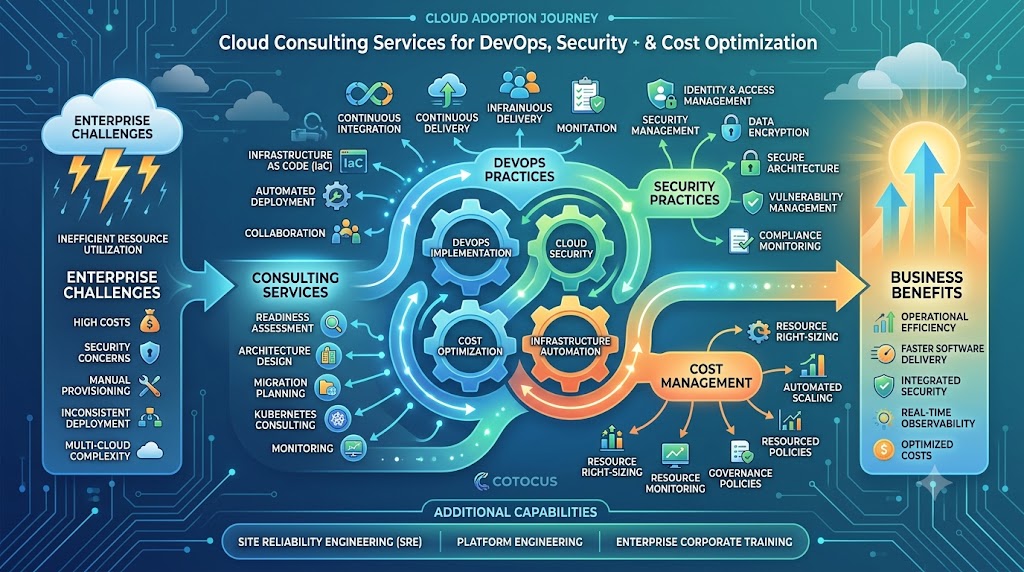
Cloud computing has transformed the way enterprises build, deploy, and manage applications. Organizations are moving beyond traditional on-premises infrastructure to embrace scalable, flexible, and cloud-native environments that support faster innovation and improved business agility. However, simply migrating workloads to the cloud does not automatically deliver these benefits. Enterprises need a well-defined cloud strategy, robust security practices, efficient resource management, and automation to maximize the value of their cloud investments. This is where professional Cloud Consulting Services become essential.
Cloud consulting helps organizations design secure architectures, modernize applications, automate infrastructure, optimize operational costs, and align cloud technologies with business objectives. Combined with DevOps practices, security integration, and governance frameworks, cloud consulting enables businesses to build resilient digital platforms while maintaining compliance and operational efficiency.
Cotocus provides cloud consulting services that help enterprises accelerate cloud adoption through DevOps implementation, cloud migration, Kubernetes consulting, infrastructure automation, DevSecOps, Site Reliability Engineering (SRE), platform engineering, CI/CD optimization, and enterprise corporate training. Organizations seeking expert guidance for cloud modernization can learn more at https://www.cotocus.com/.
Why Enterprises Need Cloud Consulting Services
Cloud technology offers significant opportunities for innovation, but it also introduces challenges related to architecture, governance, security, performance, and cost management.
Many organizations face issues such as:
- Inefficient cloud resource utilization
- Increasing infrastructure costs
- Security and compliance concerns
- Manual cloud provisioning
- Limited automation
- Application modernization challenges
- Inconsistent deployment processes
- Multi-cloud complexity
- Lack of cloud governance
Professional cloud consulting helps organizations overcome these challenges through structured planning, technical expertise, and proven implementation methodologies.
What Cloud Consulting Services Include
Cloud consulting goes beyond infrastructure deployment. It covers the complete lifecycle of cloud transformation, from strategy and architecture to optimization and continuous improvement.
Typical consulting services include:
- Cloud readiness assessment
- Cloud architecture design
- Cloud migration planning
- Infrastructure automation
- DevOps implementation
- Kubernetes consulting
- Security architecture
- Cost optimization
- Monitoring and observability
- Disaster recovery planning
- Governance and compliance
- Enterprise cloud training
These services help organizations create secure, scalable, and efficient cloud environments.
DevOps as the Foundation of Cloud Success
Cloud platforms and DevOps work together to improve software delivery, operational efficiency, and business agility.
DevOps consulting within cloud environments focuses on:
Continuous Integration and Continuous Delivery
Automated CI/CD pipelines streamline software development, testing, and deployment, enabling faster and more reliable releases.
Infrastructure as Code
Infrastructure provisioning becomes automated, repeatable, and version-controlled, reducing manual effort and configuration errors.
Automated Deployment
Applications can be deployed consistently across development, testing, staging, and production environments.
Collaboration
DevOps encourages closer collaboration between development, operations, quality assurance, and security teams.
Together, these practices create an efficient software delivery ecosystem that supports rapid innovation.
Cloud Security from Design to Operations
Security is one of the most important aspects of cloud adoption. A secure cloud environment protects business data, applications, and infrastructure while meeting regulatory and compliance requirements.
Cloud consulting services help organizations implement:
- Identity and Access Management (IAM)
- Multi-factor authentication
- Data encryption
- Network segmentation
- Secure cloud architecture
- Vulnerability management
- Compliance monitoring
- Secrets management
- Continuous security assessments
By integrating DevSecOps principles, security becomes an ongoing process rather than a final checkpoint.
Infrastructure Automation for Operational Efficiency
Manual infrastructure management often results in inconsistent environments and increased operational overhead.
Infrastructure automation enables organizations to:
- Provision cloud resources automatically
- Standardize infrastructure deployment
- Improve environment consistency
- Accelerate application delivery
- Reduce manual configuration
- Strengthen governance
Infrastructure as Code (IaC) also simplifies disaster recovery and environment replication.
Kubernetes and Cloud-Native Applications
Containerization has become a standard approach for deploying modern applications, and Kubernetes is the preferred platform for orchestrating containerized workloads.
Cloud consulting services assist with:
- Kubernetes architecture
- Cluster deployment
- Application migration
- Workload management
- Security hardening
- High availability
- Monitoring integration
- Performance optimization
These capabilities allow enterprises to run cloud-native applications with greater reliability and scalability.
Cost Optimization in the Cloud
One of the biggest concerns for organizations is controlling cloud spending while maintaining performance.
Cloud consulting helps optimize costs by focusing on:
Resource Right-Sizing
Matching compute, storage, and networking resources to actual business requirements.
Automated Scaling
Scaling resources automatically based on workload demand prevents unnecessary spending.
Resource Monitoring
Continuous monitoring identifies unused or underutilized cloud resources.
Governance Policies
Standardized governance helps prevent uncontrolled resource provisioning.
Infrastructure Automation
Automated provisioning reduces operational inefficiencies and improves resource utilization.
Effective cost optimization ensures organizations receive maximum value from their cloud investments.
Site Reliability Engineering (SRE)
Cloud environments require proactive operational management to maintain availability and performance.
Site Reliability Engineering focuses on:
- Monitoring
- Observability
- Incident response
- Service Level Indicators (SLIs)
- Service Level Objectives (SLOs)
- Capacity planning
- Automation
- Performance optimization
SRE practices help organizations improve service reliability while reducing operational disruptions.
Platform Engineering for Better Developer Experience
Platform engineering creates standardized internal platforms that simplify cloud adoption and software delivery.
Benefits include:
- Self-service infrastructure
- Consistent development environments
- Faster onboarding
- Standardized deployment workflows
- Improved governance
- Better developer productivity
These platforms reduce operational complexity while enabling engineering teams to focus on application development.
Enterprise Cloud Training
Technology transformation succeeds when employees understand how to use modern cloud technologies effectively.
Corporate cloud training often includes:
- Cloud fundamentals
- DevOps practices
- Kubernetes
- Infrastructure as Code
- DevSecOps
- CI/CD
- Cloud security
- Monitoring
- GitOps
- Platform engineering
Hands-on learning prepares IT teams to manage cloud environments with confidence.
Business Benefits of Cloud Consulting Services
Organizations that invest in cloud consulting often experience significant operational and business improvements.
| Traditional IT Infrastructure | Modern Cloud Environment |
|---|---|
| Fixed infrastructure capacity | Elastic cloud scalability |
| Manual provisioning | Infrastructure automation |
| Separate development and operations | DevOps collaboration |
| Reactive security | Integrated DevSecOps |
| High capital expenditure | Optimized operational costs |
| Slow software deployment | Automated CI/CD pipelines |
| Limited monitoring | Real-time observability |
| Manual scaling | Automated resource scaling |
| Inconsistent environments | Standardized cloud governance |
Why Enterprises Choose Cotocus
Successful cloud transformation requires more than technical expertise. It requires strategic planning, practical implementation, workforce enablement, and continuous optimization.
Cotocus helps enterprises modernize cloud environments through cloud consulting, DevOps implementation, Kubernetes consulting, infrastructure automation, DevSecOps, Site Reliability Engineering, platform engineering, CI/CD optimization, cloud governance, and enterprise corporate training. By combining consulting with knowledge transfer, Cotocus enables organizations to build long-term cloud capabilities that support innovation and sustainable business growth.
Frequently Asked Questions
What are Cloud Consulting Services?
Cloud Consulting Services help organizations design, implement, secure, optimize, and manage cloud environments that support business growth and digital transformation.
How does DevOps support cloud adoption?
DevOps introduces automation, CI/CD pipelines, Infrastructure as Code, and collaborative workflows that improve cloud operations and accelerate software delivery.
Why is cloud security important?
Cloud security protects applications, infrastructure, and business data through identity management, encryption, monitoring, compliance, and continuous risk assessment.
What is Infrastructure as Code?
Infrastructure as Code automates infrastructure provisioning using version-controlled templates, improving consistency and reducing manual configuration.
How does Kubernetes improve cloud operations?
Kubernetes automates container orchestration, improves scalability, supports high availability, and simplifies cloud-native application management.
What is cloud cost optimization?
Cloud cost optimization involves managing cloud resources efficiently to reduce unnecessary spending while maintaining performance and reliability.
Why is Site Reliability Engineering important?
SRE improves application availability through monitoring, automation, incident response, capacity planning, and operational best practices.
What role does DevSecOps play in cloud consulting?
DevSecOps integrates security throughout the software development and deployment lifecycle, helping organizations build secure cloud environments.
Why should enterprises invest in cloud training?
Corporate cloud training develops internal expertise, improves technology adoption, and enables teams to manage cloud environments more effectively.
Why choose Cotocus for cloud consulting?
Cotocus combines cloud consulting expertise, DevOps implementation, Kubernetes services, infrastructure automation, DevSecOps, Site Reliability Engineering, platform engineering, and enterprise training to help organizations build secure, scalable, and cost-efficient cloud environments.
Conclusion
Cloud Consulting Services help enterprises maximize the value of cloud investments by combining DevOps automation, cloud security, infrastructure modernization, Kubernetes, Site Reliability Engineering, and cost optimization strategies. A structured cloud consulting approach enables organizations to build resilient, scalable, and secure technology platforms that support continuous innovation and long-term business success.
Cotocus partners with enterprises to deliver cloud consulting, implementation support, automation expertise, and corporate training that simplify cloud transformation while improving operational efficiency. Whether your organization is planning a cloud migration, strengthening cloud security, optimizing cloud costs, or adopting DevOps practices, https://www.cotocus.com/ provides the consulting expertise and enterprise solutions needed to achieve sustainable digital transformation.
