Introduction
Modern IT environments are more complex than ever. Organizations run applications across cloud platforms, containers, microservices, hybrid infrastructures, and distributed networks. Traditional monitoring tools generate thousands of alerts daily, making it difficult for operations teams to identify critical incidents, determine root causes, and maintain service reliability.
This is where AIOps comes into the picture.
AIOps, or Artificial Intelligence for IT Operations, combines machine learning, big data analytics, automation, and observability to help organizations manage IT systems more intelligently. Instead of manually analyzing logs, metrics, traces, and events, AIOps platforms can automatically detect anomalies, correlate incidents, identify root causes, and even trigger remediation actions.
As enterprises increasingly adopt AI-driven operations, the demand for professionals with AIOps skills continues to grow. Whether you are a system administrator, DevOps engineer, SRE, cloud architect, IT operations professional, or technology leader, AIOps training and certification can help you stay relevant in the future of IT operations.
This guide explores everything you need to know about AIOps training, certification paths, career opportunities, required skills, tools, and learning roadmaps.
What Is AIOps?
AIOps stands for Artificial Intelligence for IT Operations. It uses artificial intelligence and machine learning techniques to automate and enhance IT operations management.
An AIOps platform typically collects data from multiple sources including:
- Infrastructure monitoring systems
- Application performance monitoring tools
- Log management platforms
- Cloud environments
- Network monitoring systems
- Service desk applications
- Security monitoring solutions
The platform then analyzes this data to:
- Detect anomalies
- Correlate events
- Predict incidents
- Identify root causes
- Automate remediation workflows
- Improve operational efficiency
AIOps transforms reactive IT operations into proactive and predictive operations.
Why AIOps Matters Today
Organizations face several challenges in modern IT environments:
Alert Overload
Thousands of alerts are generated every day, making it difficult for teams to prioritize critical incidents.
Complex Infrastructure
Hybrid cloud, multi-cloud, containers, Kubernetes, and microservices create massive operational complexity.
Faster Incident Resolution
Businesses expect minimal downtime and rapid service restoration.
Growing Data Volumes
IT environments generate terabytes of logs, metrics, traces, and events daily.
Operational Efficiency
Organizations seek automation opportunities to reduce manual work and operational costs.
AIOps addresses these challenges through intelligence, automation, and predictive analytics.
Key Components of AIOps
Data Collection
AIOps platforms collect operational data from various IT systems.
Examples include:
- Logs
- Metrics
- Traces
- Events
- Configuration data
- Service desk tickets
Machine Learning
Machine learning algorithms analyze historical and real-time operational data.
Capabilities include:
- Pattern recognition
- Trend analysis
- Anomaly detection
- Forecasting
Event Correlation
AIOps platforms combine multiple alerts into meaningful incidents.
Instead of receiving hundreds of alerts, teams receive one correlated incident.
Root Cause Analysis
AI helps identify the source of a problem faster than traditional troubleshooting methods.
Automation
Automated workflows can perform remediation tasks without human intervention.
Examples:
- Restart services
- Scale infrastructure
- Open tickets
- Notify teams
- Trigger runbooks
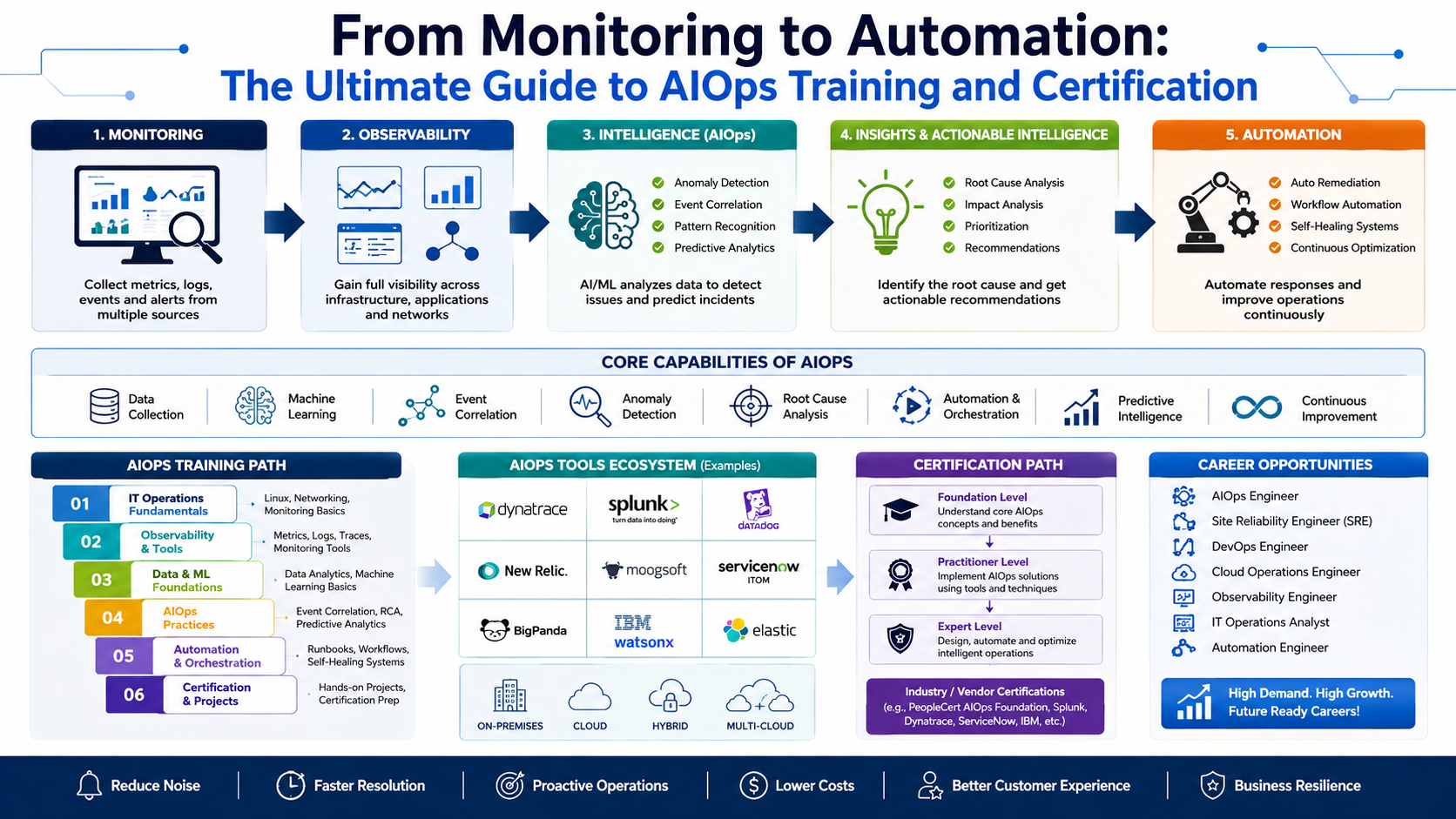
The Evolution from Monitoring to Automation
Traditional Monitoring
Traditional monitoring focuses on collecting metrics and generating alerts.
Characteristics:
- Manual analysis
- Alert storms
- Reactive response
- Limited automation
Advanced Observability
Observability provides deeper visibility into systems.
Capabilities:
- Metrics analysis
- Distributed tracing
- Log analytics
- User experience monitoring
Intelligent Operations
AIOps introduces intelligence into observability.
Benefits:
- Reduced noise
- Automated insights
- Predictive analytics
- Faster troubleshooting
Autonomous Operations
The final stage involves self-healing systems.
Capabilities:
- Automated remediation
- Dynamic scaling
- Predictive maintenance
- Continuous optimization
Who Should Learn AIOps?
AIOps is valuable for multiple technology roles.
DevOps Engineers
Improve automation and operational efficiency.
Site Reliability Engineers
Reduce downtime and improve service reliability.
System Administrators
Manage infrastructure proactively.
Cloud Engineers
Optimize cloud operations and resource utilization.
IT Operations Professionals
Modernize operational workflows and incident management.
Monitoring Engineers
Move beyond traditional monitoring approaches.
Platform Engineers
Build intelligent infrastructure platforms.
Technology Managers
Lead digital transformation initiatives.
Skills You Need for AIOps
Successful AIOps professionals typically possess a combination of technical and analytical skills.
Monitoring Fundamentals
Understanding:
- Infrastructure monitoring
- Application monitoring
- Network monitoring
Observability
Knowledge of:
- Metrics
- Logs
- Traces
- Telemetry data
Cloud Platforms
Experience with:
- AWS
- Azure
- Google Cloud
Automation
Skills in:
- Scripting
- Infrastructure as Code
- Workflow automation
Data Analysis
Ability to analyze operational data effectively.
Machine Learning Basics
Understanding:
- Anomaly detection
- Classification
- Predictive analytics
- Pattern recognition
Incident Management
Knowledge of IT service management processes.
What You Learn in an AIOps Training Program
A comprehensive AIOps course typically covers:
Module 1: AIOps Fundamentals
- Introduction to AIOps
- Industry trends
- Business value
- AIOps architecture
Module 2: Monitoring and Observability
- Metrics
- Logging
- Tracing
- Monitoring tools
Module 3: Data Collection and Analytics
- Data ingestion
- Data normalization
- Operational analytics
Module 4: Machine Learning for Operations
- AI concepts
- Machine learning models
- Predictive analytics
Module 5: Event Correlation
- Alert management
- Event aggregation
- Noise reduction
Module 6: Root Cause Analysis
- Incident investigation
- Correlation techniques
- Dependency mapping
Module 7: Automation and Remediation
- Runbooks
- Workflow automation
- Self-healing systems
Module 8: Real-World AIOps Use Cases
- Cloud operations
- DevOps pipelines
- SRE workflows
- Enterprise IT operations
Popular AIOps Tools You Should Know
Dynatrace
AI-powered observability and automation platform.
Splunk ITSI
Advanced analytics and incident intelligence.
IBM Watson AIOps
Enterprise-grade AIOps platform with AI capabilities.
Moogsoft
Focused on event correlation and incident management.
BigPanda
Known for alert correlation and operational intelligence.
Datadog
Comprehensive observability and monitoring platform.
New Relic
Application monitoring and intelligent observability.
PagerDuty
Incident response automation and operational resilience.
ServiceNow ITOM
AI-driven IT operations management platform.
Elastic Observability
Open-source observability and analytics platform.
AIOps Certification Options
Certification validates your expertise and improves professional credibility.
Foundation-Level Certifications
Suitable for beginners.
Focus areas:
- Core concepts
- Terminology
- Business value
- Industry applications
Practitioner-Level Certifications
Designed for professionals implementing AIOps solutions.
Focus areas:
- Tool usage
- Automation workflows
- Operational analytics
Vendor-Specific Certifications
Available from platform vendors.
Examples include:
- Dynatrace certifications
- Splunk certifications
- ServiceNow certifications
- Datadog certifications
Enterprise AIOps Certifications
Focus on real-world operational transformation and governance.
Benefits of AIOps Certification
Career Growth
Certified professionals often qualify for more advanced technical roles.
Industry Recognition
Certification demonstrates validated expertise.
Better Job Opportunities
Organizations increasingly seek professionals with AI and automation skills.
Higher Earning Potential
Specialized skills often command premium compensation.
Practical Knowledge
Structured learning improves real-world implementation capabilities.
Future-Proof Career
AIOps aligns with emerging trends in automation and intelligent operations.
AIOps Career Opportunities
Growing adoption of AI-driven operations creates numerous career opportunities.
Common job roles include:
- AIOps Engineer
- Site Reliability Engineer
- DevOps Engineer
- Cloud Operations Engineer
- Platform Engineer
- Monitoring Specialist
- Infrastructure Automation Engineer
- IT Operations Analyst
- Observability Engineer
- Digital Operations Manager
Learning Roadmap for Beginners
Phase 1: Learn IT Operations Basics
Focus on:
- Linux
- Networking
- System administration
- Monitoring fundamentals
Phase 2: Learn Cloud Computing
Gain experience with:
- AWS
- Azure
- Google Cloud
Phase 3: Learn DevOps
Understand:
- CI/CD
- Containers
- Kubernetes
- Infrastructure as Code
Phase 4: Learn Observability
Master:
- Metrics
- Logs
- Traces
- Monitoring platforms
Phase 5: Learn Automation
Practice:
- Python
- Shell scripting
- Workflow automation
Phase 6: Learn AIOps
Study:
- Event correlation
- Machine learning concepts
- Predictive analytics
- Root cause analysis
Phase 7: Earn Certification
Validate your skills through recognized certification programs.
Real-World AIOps Use Cases
Incident Prediction
Predict service failures before users are affected.
Root Cause Analysis
Identify underlying issues quickly.
Capacity Planning
Forecast future infrastructure requirements.
Cloud Cost Optimization
Optimize resource utilization and spending.
Security Monitoring
Detect unusual patterns and suspicious activities.
Self-Healing Systems
Automatically remediate known issues.
Service Reliability
Improve uptime and user experience.
How to Choose the Right AIOps Training Program
Consider the following factors:
Comprehensive Curriculum
Ensure coverage of monitoring, observability, AI, automation, and operations.
Hands-On Labs
Practical exercises accelerate learning.
Industry-Relevant Tools
Training should include modern AIOps platforms.
Expert Instructors
Learn from experienced practitioners.
Certification Preparation
Choose programs aligned with industry-recognized certifications.
Real-World Projects
Projects help build practical implementation experience.
Career Support
Look for mentoring, guidance, and community access.
The Future of AIOps
The future of IT operations will increasingly depend on intelligent automation.
Emerging trends include:
- Autonomous operations
- Generative AI integration
- Predictive incident prevention
- Self-healing infrastructure
- AI-powered observability
- Intelligent service management
- Hyperautomation
Organizations that embrace AIOps will gain operational efficiency, improved reliability, and faster innovation.
Professionals who develop AIOps expertise today will be well-positioned to lead tomorrow’s intelligent IT operations environments.
Conclusion
AIOps represents the next evolution of IT operations, combining artificial intelligence, machine learning, observability, and automation to manage increasingly complex digital environments. As organizations move beyond traditional monitoring toward predictive analytics and autonomous operations, the demand for skilled AIOps professionals continues to grow. By investing in AIOps training and certification, technology professionals can develop expertise in anomaly detection, event correlation, root cause analysis, automation, and intelligent operations management. Whether your goal is career advancement, operational excellence, or future-proofing your skills, AIOps provides a powerful pathway into the future of modern IT operations.
