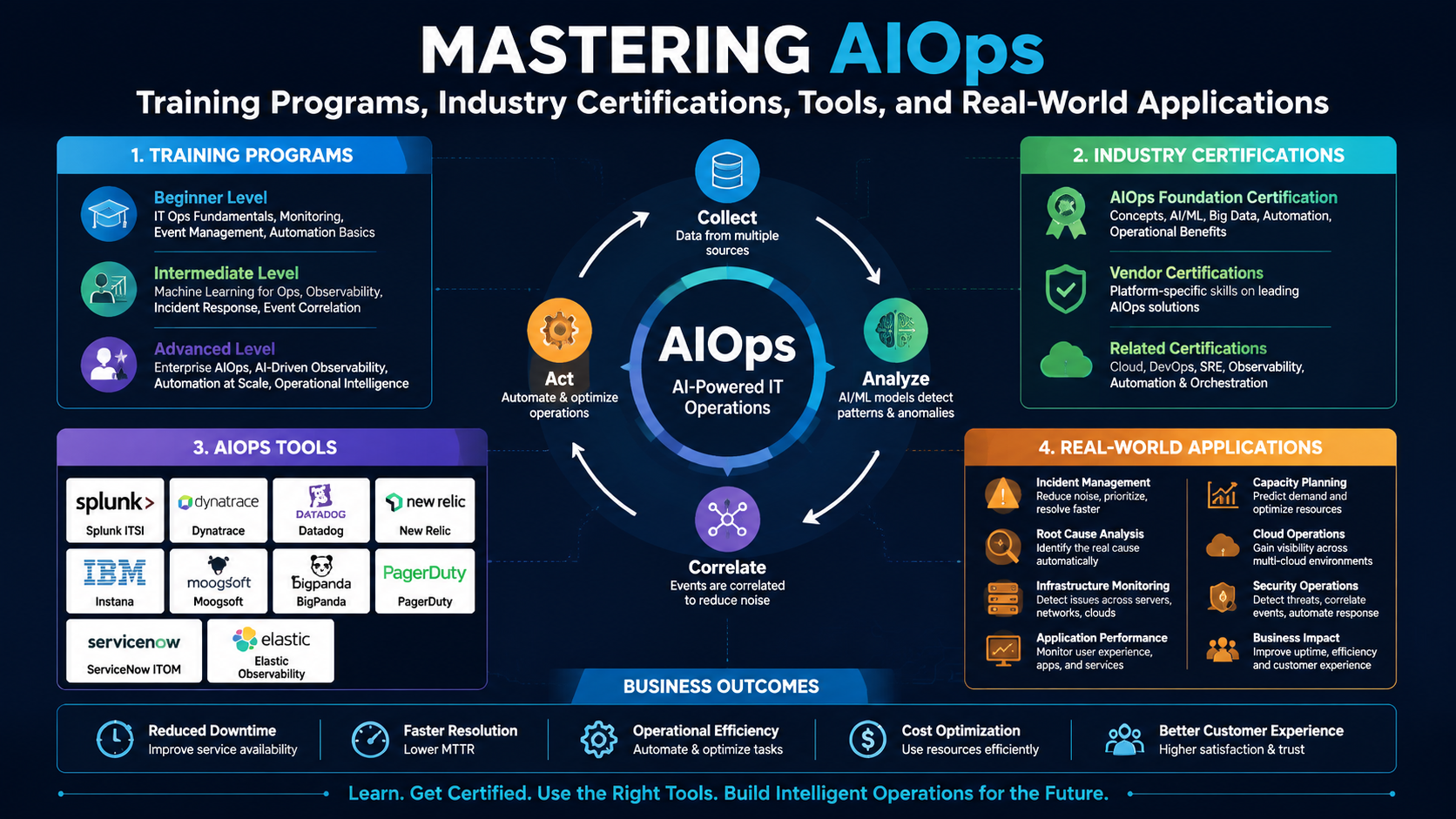
Introduction
As modern IT environments become increasingly complex, organizations are struggling to manage vast amounts of operational data generated by applications, infrastructure, cloud platforms, networks, and security systems. Traditional monitoring and operations approaches often fail to provide the speed and intelligence needed to identify issues before they impact business performance.
This is where AIOps, or Artificial Intelligence for IT Operations, is transforming the industry. By combining artificial intelligence, machine learning, big data analytics, and automation, AIOps enables organizations to detect anomalies, correlate events, identify root causes, predict incidents, and automate remediation processes.
Whether you are an IT professional, DevOps engineer, Site Reliability Engineer, cloud architect, or operations manager, learning AIOps can help you stay ahead in the rapidly evolving world of intelligent IT operations. This guide explores AIOps training programs, certifications, essential tools, and real-world applications to help you master this critical technology.
What is AIOps?
AIOps stands for Artificial Intelligence for IT Operations. It refers to the application of machine learning, analytics, and automation technologies to improve and automate IT operations tasks.
The primary goal of AIOps is to transform large volumes of operational data into actionable insights that help organizations:
- Detect issues faster
- Reduce alert fatigue
- Improve incident response
- Accelerate root cause analysis
- Predict failures before they occur
- Automate repetitive operational tasks
AIOps platforms continuously collect data from multiple sources, analyze patterns, detect anomalies, and recommend or execute corrective actions automatically.
Why AIOps Matters in Modern IT Operations
Today’s enterprises operate across:
- Hybrid cloud environments
- Multi-cloud platforms
- Kubernetes clusters
- Microservices architectures
- Distributed applications
- Edge computing infrastructures
Managing these environments manually has become nearly impossible due to the volume, velocity, and variety of operational data generated every second.
AIOps helps organizations overcome these challenges by providing:
Intelligent Event Correlation
Thousands of alerts can be correlated into a single actionable incident.
Faster Root Cause Analysis
Machine learning identifies the most probable source of a problem.
Predictive Operations
Potential failures are identified before users experience outages.
Operational Efficiency
Teams spend less time managing alerts and more time improving systems.
Improved Customer Experience
Reduced downtime leads to better service availability and customer satisfaction.
Core Components of AIOps
A successful AIOps implementation typically includes several key capabilities.
Data Collection
AIOps platforms collect information from:
- Monitoring systems
- Application logs
- Infrastructure metrics
- Network devices
- Cloud platforms
- Security tools
- Service management systems
Data Aggregation
Collected data is centralized for analysis and correlation.
Machine Learning Analytics
Algorithms analyze operational patterns and identify anomalies.
Event Correlation
Related events are grouped together to reduce noise.
Root Cause Analysis
Systems identify likely causes of incidents automatically.
Automation and Orchestration
Routine remediation actions can be executed without human intervention.
Essential Skills for AIOps Professionals
Professionals pursuing AIOps careers should develop expertise across multiple domains.
IT Operations
Understanding infrastructure, monitoring, incident management, and service operations.
Cloud Computing
Knowledge of cloud platforms and distributed architectures.
DevOps Practices
Continuous integration, continuous deployment, and automation workflows.
Machine Learning Fundamentals
Basic understanding of AI and machine learning concepts.
Observability
Logs, metrics, traces, and monitoring strategies.
Automation Tools
Scripting and orchestration technologies for operational automation.
Data Analytics
Analyzing operational data and identifying meaningful patterns.
AIOps Training Programs
Quality training is the foundation of mastering AIOps.
Beginner-Level Training
Ideal for:
- System administrators
- Network engineers
- IT support professionals
- Operations analysts
Topics typically include:
- Introduction to AIOps
- IT operations fundamentals
- Monitoring concepts
- Event management
- Automation basics
Intermediate-Level Training
Designed for:
- DevOps engineers
- Cloud engineers
- SRE professionals
- Platform engineers
Topics include:
- Machine learning in operations
- Observability platforms
- Incident response automation
- Event correlation
- Predictive analytics
Advanced AIOps Training
Targeted at:
- Solution architects
- Enterprise architects
- Operations leaders
- Digital transformation teams
Advanced topics include:
- Enterprise AIOps implementation
- Large-scale automation
- AI-driven observability
- Operational intelligence
- Business impact analytics
Popular AIOps Certifications
Certifications validate your expertise and improve career opportunities.
AIOps Foundation Certification
A widely recognized certification covering:
- AIOps concepts
- AI and machine learning basics
- Big data analytics
- Operational automation
- Organizational benefits
Vendor-Specific Certifications
Many technology vendors offer specialized certifications focusing on their AIOps platforms and operational intelligence solutions.
These certifications typically cover:
- Platform deployment
- Event management
- Monitoring integration
- Automation workflows
- Performance optimization
Cloud and Observability Certifications
Related certifications that complement AIOps skills include:
- Cloud platform certifications
- DevOps certifications
- Site Reliability Engineering programs
- Observability certifications
- Automation and orchestration credentials
Leading AIOps Tools in the Industry
Several platforms dominate the AIOps market.
Splunk IT Service Intelligence
Known for powerful analytics, anomaly detection, and operational visibility.
Dynatrace
Provides AI-powered observability, root cause analysis, and automation.
Datadog
Combines monitoring, observability, and operational intelligence capabilities.
New Relic
Offers full-stack observability with AI-assisted incident management.
IBM Instana
Focuses on application performance monitoring and automated root cause analysis.
Moogsoft
Specializes in event correlation and noise reduction.
BigPanda
Provides intelligent incident management and event aggregation.
PagerDuty AIOps
Enhances incident response with machine learning and automation.
ServiceNow IT Operations Management
Integrates AIOps capabilities with IT service management processes.
Elastic Observability
Combines search, analytics, and observability with intelligent insights.
Real-World Applications of AIOps
AIOps is delivering measurable business value across industries.
Incident Management
Organizations use AIOps to:
- Reduce alert noise
- Prioritize incidents
- Accelerate response times
- Improve resolution accuracy
Root Cause Analysis
Instead of manually investigating thousands of events, AIOps identifies probable causes automatically.
Infrastructure Monitoring
AIOps continuously analyzes:
- CPU utilization
- Memory consumption
- Network traffic
- Storage performance
to identify emerging issues.
Application Performance Monitoring
AI-powered analytics detect:
- Latency spikes
- Transaction failures
- Service degradation
- User experience problems
before they impact customers.
Capacity Planning
Predictive analytics help organizations:
- Forecast resource demand
- Optimize infrastructure investments
- Prevent performance bottlenecks
Cloud Operations
AIOps improves visibility across:
- Public clouds
- Private clouds
- Hybrid environments
- Multi-cloud deployments
Security Operations
Many organizations leverage AIOps for:
- Threat detection
- Behavioral analysis
- Security event correlation
- Automated response workflows
AIOps for DevOps and SRE Teams
AIOps and DevOps work together to create highly efficient operational environments.
Benefits include:
- Faster deployment validation
- Reduced operational risks
- Automated incident response
- Improved service reliability
- Better observability
For Site Reliability Engineering teams, AIOps helps maintain service level objectives while reducing manual operational workloads.
Career Opportunities in AIOps
As enterprises increasingly adopt AI-driven operations, demand for skilled professionals continues to grow.
Popular job roles include:
- AIOps Engineer
- Site Reliability Engineer
- DevOps Engineer
- Cloud Operations Engineer
- Platform Engineer
- Observability Engineer
- Automation Architect
- IT Operations Manager
- Digital Transformation Consultant
Professionals with AIOps expertise often combine skills in operations, cloud computing, automation, analytics, and artificial intelligence.
Building Your AIOps Learning Roadmap
A structured approach can accelerate your learning journey.
Step 1: Learn IT Operations Fundamentals
Understand monitoring, incident management, and infrastructure management.
Step 2: Study Cloud Technologies
Gain experience with modern cloud environments.
Step 3: Learn DevOps Practices
Develop automation and deployment skills.
Step 4: Explore Observability
Master logs, metrics, traces, and monitoring systems.
Step 5: Understand Machine Learning Basics
Learn how AI models detect patterns and anomalies.
Step 6: Practice with AIOps Tools
Work with leading platforms through labs and projects.
Step 7: Earn Certifications
Validate your knowledge through industry-recognized credentials.
Step 8: Build Real-World Projects
Apply AIOps concepts to realistic operational scenarios.
The Future of AIOps
The future of IT operations is becoming increasingly autonomous. Organizations are moving toward self-healing systems capable of detecting, diagnosing, and resolving issues with minimal human intervention.
Emerging trends include:
- Autonomous operations
- Predictive remediation
- AI-driven observability
- Generative AI for operations
- Intelligent automation
- Hyperautomation
- Self-healing infrastructure
As these technologies mature, AIOps will become a core capability for modern digital enterprises.
Conclusion
AIOps is rapidly becoming one of the most valuable disciplines in modern IT operations. By combining artificial intelligence, machine learning, analytics, and automation, organizations can significantly improve operational efficiency, reduce downtime, accelerate incident resolution, and enhance customer experiences. For professionals, mastering AIOps opens doors to high-demand roles in DevOps, SRE, cloud operations, and digital transformation initiatives. Through structured training programs, industry certifications, hands-on experience with leading tools, and exposure to real-world applications, learners can build the expertise needed to succeed in the future of intelligent IT operations. Whether you are just beginning your journey or looking to advance your existing skills, now is the ideal time to invest in AIOps knowledge and become part of the next generation of IT operations professionals.
